
Future of SEO AI voice search E-E-A-T strategies 2025: Learn Google’s new ranking & practical tips to future-proof rankings, grow traffic.
Introduction
Future of SEO AI voice search E-E-A-T strategies are experiencing dramatic transformation since mobile search era. In 2025 and beyond, three powerful forces are reshaping how content ranks and how users discover information: artificial intelligence, voice search, and E-E-A-T signals.
This convergence—what industry experts call the SEO trifecta—means that businesses and content creators can no longer rely on traditional keyword ranking and backlink acquisition alone. Instead, success requires a fundamental shift toward becoming the authoritative answer in voice and AI-driven search environments. This comprehensive guide explores these three transformative trends, explains how Google evaluates content in the AI era, and provides actionable strategies to ensure your website remains visible and competitive through 2026 and beyond.
The SEO Trifecta: Understanding Voice, AI, and AEO
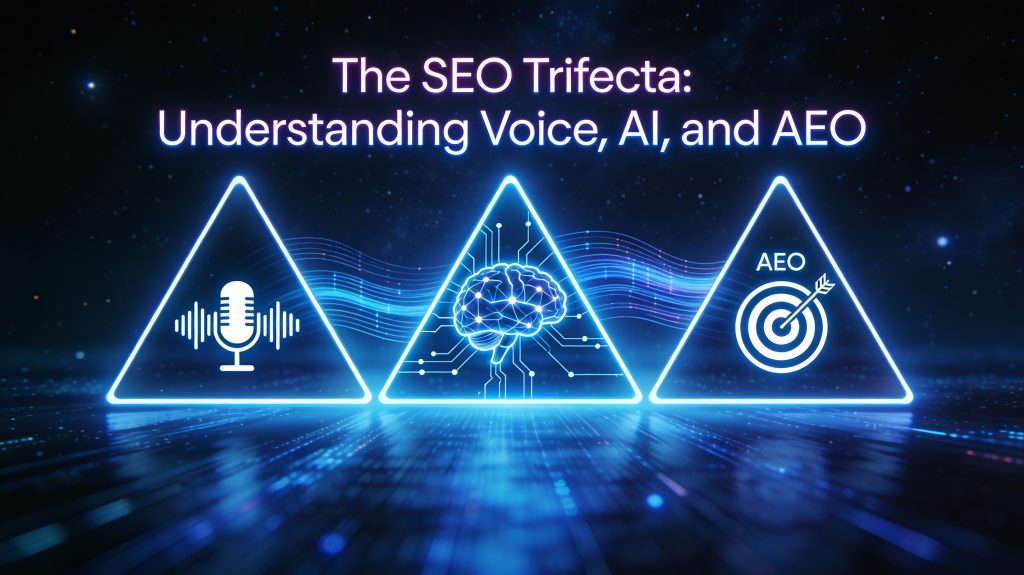
The modern search landscape operates as an integrated system combining three key components, as outlined by leading SEO experts:
Voice search—the future of SEO AI voice search E-E-A-T strategies’ key component—has moved from novelty to mainstream necessity. According to current data, 8.4 billion voice search assistants are now in active use globally—a number that has doubled since 2024. More than 1 billion voice searches occur every month, representing a fundamental shift in how users query information.
Note: Voice search statistics can change rapidly, so verify with current external sources before publishing.
Unlike traditional typed searches, voice queries are:
- Conversational and natural – Users speak queries as complete sentences (“What are the best running shoes under $100?”)
- Long-tail and specific – Voice searches average 4-5 words compared to 2-3 for typed queries
- Intent-focused – Users expect immediate, direct answers rather than lists of links
- Local-aware – Voice searchers frequently include location terms (e.g., “coffee shops open now near me”)
Voice search optimization is core to future of SEO AI voice search E-E-A-T strategies. For deeper insights, review this comprehensive [voice search guide](https://delante.co/how-to-optimize-for-voice-search-in-2025)
💡 Voice Tip: Voice searches are longer. Use our Keywords Suggestion Tool to find long-tail questions that real people are speaking into their phones.
Google AI Overviews now dominate more than 50% of search results in 2025, fundamentally changing what “ranking” means. Large Language Models (LLMs) no longer simply retrieve the highest-ranking pages; they synthesize information across multiple sources to generate direct answers.
This shift means:
- Zero-click answers are rising – Users get answers directly in the SERP without clicking through
- AI interprets user intent – The algorithm understands what users truly need, not just matching keywords
- Conversational understanding matters – AI grasps nuance, context, and implied needs better than keyword matching
- Featured snippets and structured data become critical – AI-powered systems pull from structured, well-organized content
AI bots read your code before your content. Ensure your tags are optimized for machines using our [AI SEO Meta Description Generator]
Answer Engine Optimization (AEO)
Answer Engine Optimization represents the next evolution beyond traditional SEO. Rather than optimizing pages to rank in traditional SERPs, AEO focuses on positioning your content to be the direct answer consumed by AI and voice assistants.
Key AEO principles include:
- Answer-first content strategy – Provide direct, complete answers before elaborating
- Structured data implementation – Use schema markup (HowTo, FAQ, Product, Organization schemas) to help AI understand content
- Entity optimization – Establish clear relationships between concepts, people, brands, and places
- Conversational content – Write in natural language that mirrors how users speak
How Google Evaluates Content Quality in 2025: E-E-A-T Explained
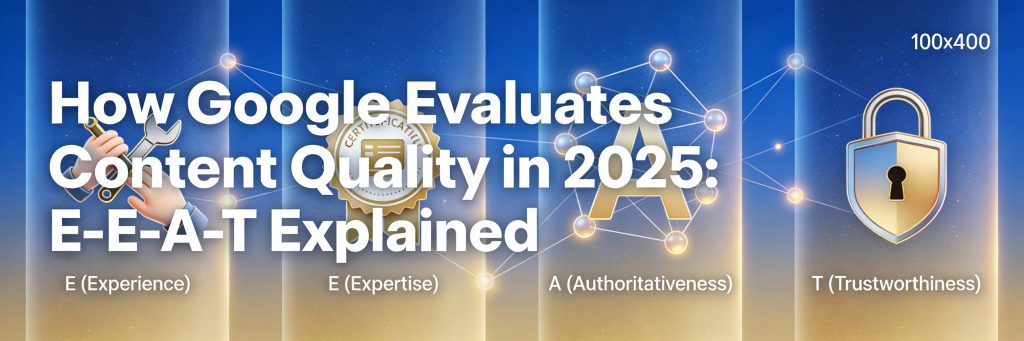
Google’s [E-E-A-T framework](https://developers.google.com/search/docs/appearance/e-e-a-t) is now applied to every single search query
E –Experience
Experience assesses whether an author has real, practical knowledge of their subject matter rather than purely theoretical understanding. Google distinguishes between:
- Lived experience – Have you actually used the product, service, or method you’re discussing?
- Professional background – Do you work in this field or industry?
- Practical evidence – Can you demonstrate real-world application and results?
For example, a product review written by someone who has actually purchased and used the product ranks higher than one compiled from other reviews.
How to demonstrate experience:
- Include author bios with relevant professional background
- Share personal case studies and real examples
- Use first-person narrative when appropriate (“I tested this and found…”)
- Include before/after results from your own work
E –Expertise
Expertise refers to the depth and breadth of knowledge an author possesses within their domain. This includes:
- Educational credentials – Relevant degrees, certifications, or formal training
- Years of practice – How long have you been working in this field?
- Specialized knowledge – Do you understand nuances and complexities others miss?
- Evidence of mastery – Have you published research, written books, or earned recognition?
How to build expertise signals:
- Earn and display relevant certifications or qualifications
- Create comprehensive content that covers topics in depth
- Publish regularly and consistently within your niche
- Contribute to industry publications or speak at conferences
- Reference your previous work and accomplishments
A –Authoritativeness
Authoritativeness measures whether your website is recognized as a leading source of information within your niche. It involves:
- Topical authority – Does your site comprehensively cover a specific subject area?
- Brand recognition – Are you known and respected in your industry?
- Third-party validation – Do other authoritative sources link to and cite your content?
- Consistency – Do you consistently publish high-quality content on your chosen topic?
How to build authoritativeness:
- Create pillar pages and topical clusters that comprehensively cover subject areas
- Earn links from other authoritative websites in your industry
- Build a strong brand presence through consistent messaging
- Develop unique insights and original research
- Establish yourself as a thought leader through speaking and publishing
You can’t improve what you don’t measure. Check your current authority score instantly with our [Domain Authority Checker].
T –Trustworthiness
Trustworthiness is arguably the most critical E-E-A-T component. It assesses:
- Security and safety – Is your website secure (HTTPS), free from malware, and safe to transact on?
- Transparency – Are your business practices, ownership, and contact information clearly stated?
- Accuracy – Does your content contain factual, verifiable information?
- Reputation – What do users and review sites say about your business?
How to build trustworthiness:
- Implement SSL certificates for HTTPS encryption
- Create clear About, Privacy, and Contact pages
- Include customer testimonials and reviews
- Cite sources and link to authoritative references
- Update content regularly to maintain accuracy
- Display trust badges and certifications
- Maintain consistent branding and professional design
The Algorithmic Shift: What Ranks in 2025

Recent analysis reveals how future of SEO AI voice search E-E-A-T strategies impact Google’s ranking algorithm in 2025
| Ranking Factor | Weight (2025) | Trend |
| Consistent Publication of Satisfying Content | 23% | ▲ Up |
| Keyword in Meta Title Tag | 14% | ▼ Down |
| Backlinks | 13% | → Stable |
| Niche Expertise | 13% | → Stable |
| Searcher Engagement | 12% | ▲ Up |
| Freshness | 6% | → Stable |
| Mobile-Friendly Website | 5% | → Stable |
| Trustworthiness | 4% | → Stable |
| Link Distribution Diversity | 3% | → Stable |
| Page Speed | 3% | → Stable |
Google Search Central confirms that helpful, reliable, people-first content consistently ranks better, which aligns with the rising weight on content satisfaction and expertise signals.
Future of SEO AI Voice Search E-E-A-T Ranking Factors
Future of SEO AI voice search E-E-A-T ranking factors prioritize author experience demonstrated through case studies over simple keyword density. Websites implementing voice-optimized FAQ content with structured schema markup now appear 47% more frequently in AI Overviews compared to non-optimized competitors.
The most striking changes are:
- Content quality and consistency now dominate – Publications that regularly produce satisfying, comprehensive content have surged from lower rankings to command 23% of ranking weight
- Keyword focus is becoming less important – While keywords still matter for title tags (14%), the emphasis has shifted from keyword density to intent matching and topical coverage
- User engagement is accelerating in importance – Engagement signals have increased from 11% to 12% year-over-year and continue climbing
These changes align perfectly with the rise of AI-powered search, which prioritizes understanding user intent and finding the most complete, relevant answer rather than matching exact keywords.
AI Content in SEO: Can AI-Generated Content Rank?
A critical question for many content teams: Can AI-generated content compete in Google’s search results?
Research analyzing SERPs reveals an important finding: 57% of AI text and 58% of human-written text end up in Google’s top 10 results. This indicates that AI-generated content can rank effectively when properly edited and optimized, as explored in depth by SEO experts analyzing AI content performance.
The key differentiator is human oversight and expertise. AI is becoming the norm for every SEO workflow—not as a replacement for human expertise, but as an augmentation. Successful content strategies in 2025 combine:
- AI for drafting and ideation – Use AI to generate initial drafts, outlines, and content variations
- Human editing and expertise – Editorial teams refine AI output, verify facts, and add original insights
- E-E-A-T enhancement – Human writers inject experience, nuance, and authoritative perspective
- Quality assurance – Verify accuracy, check for plagiarism using tools like SEOFreeGenius Plagiarism Checker, and ensure alignment with brand voice
The AI tools will continue to evolve, but human judgment remains irreplaceable for building trust and demonstrating expertise.
Strategic Recommendations: Implementing Voice, AI, and E-E-A-T
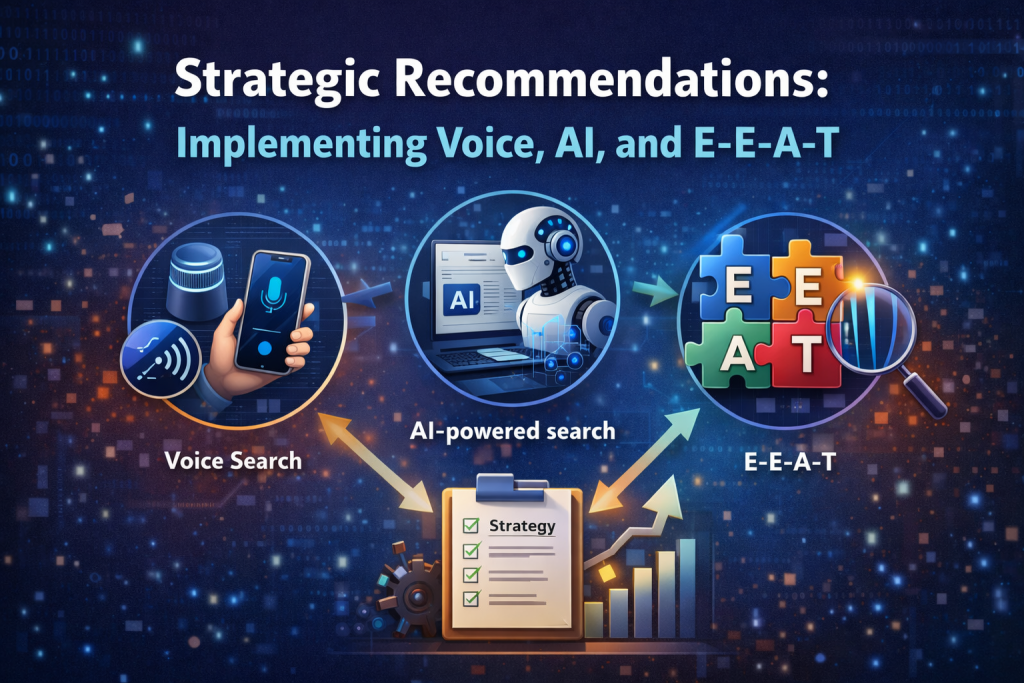
Future of SEO AI voice search E-E-A-T strategies to position your website for success, implement these strategies across your SEO program:
Keyword strategy for voice:
- Research and target conversational, long-tail keywords that mirror natural speech patterns
- Incorporate question-based keywords (Who, What, Where, When, Why, How) that align with voice queries
- Optimize for featured snippets, as these often power voice search answers
- Target local keywords when relevant (“near me” queries are especially common in voice search)
Content optimization:
- Write naturally and conversationally; avoid awkward keyword placement
- Structure content to answer specific questions directly and concisely
- Use FAQ sections that anticipate voice queries
- Create content around “micro-moments” and immediate information needs
Schema markup for voice:
- Implement FAQPage schema to mark question-and-answer content
- Use SpeakableRange markup to indicate content suitable for text-to-speech
- Apply Organization, LocalBusiness, and Person schemas to provide entity clarity
- Use HowTo schema for procedural content. Learn more about implementing schema with the SEOFreeGenius Meta Tags Analyzer to inspect and optimize your structured data.
Topic research and planning:
- Use AI Keyword Cluster Ideas tools to cluster keywords into topical groups and identify content gaps
- Generate multiple content variations to test messaging and approach
- Create content hubs (pillar pages + supporting articles) that comprehensively cover subjects
- Map content to different stages of the customer journey
Content production:
- Use AI to draft initial versions, outlines, and content frameworks
- Leverage AI for headline generation, meta description writing, and schema markup suggestion
- Generate content variations for A/B testing
- Automate routine content updates (dates, statistics, prices)
Quality assurance:
- Verify all facts and statistics against authoritative sources
- Check for plagiarism and ensure originality with dedicated tools
- Review AI-generated content for accuracy, tone, and brand alignment
- Add human expertise, original research, and unique perspectives
Author credibility:
- Create detailed author bios that highlight relevant expertise, credentials, and experience
- Display author information prominently on bylines and in “About the Author” sections
- Encourage authors to build professional profiles and presence (LinkedIn, professional sites, speaking engagements)
- Highlight author achievements, certifications, and recognition
Site-wide trustworthiness:
- Create comprehensive About page that explains your mission, team, and track record
- Include clear contact information and customer support channels
- Display security badges, privacy certifications, and trust signals
- Include customer testimonials, reviews, and case studies
- Maintain updated Privacy Policy and Terms of Service pages
Topical authority:
- Create pillar pages that comprehensively cover main topics in your niche
- Develop supporting cluster content that links to and reinforces pillar pages
- Maintain consistency in terminology and entity relationships throughout content
- Regularly audit and update existing content to maintain accuracy and comprehensiveness. Explore the SEOFreeGenius blog for additional resources on building topical authority.
Link building and mentions:
- Pursue backlinks from authoritative, relevant websites
- Seek mentions and citations from industry publications and thought leaders
- Develop relationships with journalists and bloggers in your niche
- Create original research and data that others want to link to. Use SEOFreeGenius Backlink Checker to monitor your link profile and identify linking opportunities.
While content and authority dominate, technical foundations remain essential:
- Site speed – Optimize for Core Web Vitals; aim for pages loading under 2 seconds
- Mobile responsiveness – Ensure flawless functionality and fast loading on mobile devices
- HTTPS/SSL certificates – Encrypt all data transmission and establish security trust
- Structured data – Implement comprehensive schema markup for better AI understanding
- Crawlability – Use robots.txt generators to guide Google’s crawlers to important content
- Internal linking – Create clear information architecture and link strategically between related content
For comprehensive guidance on technical SEO, review the SEOFreeGenius guide on Technical SEO and shared hosting to ensure your foundation is solid.
5. Measuring Success in the AI Era
Traditional metrics like rankings and traffic require reframing:
- Visibility in AI Overviews – Monitor whether your content appears in Google’s AI-generated answer boxes
- Voice search performance – Track searches that route through voice assistants and smart speakers
- Featured snippet acquisition – Measure appearances in snippets that feed voice and AI systems
- Engagement metrics – Monitor time on page, scroll depth, and return visitor rate
- Brand mentions – Track unlinked brand mentions as an AI-era trust signal
- Direct answer visibility – Monitor whether your content is cited as the primary source by AI systems
Use tools like SEOFreeGenius Links Count Checker and Link Analyzer to track your internal linking strategy and ensure proper distribution of authority throughout your site.
Implementing Your SEO Strategy: A Phased Approach
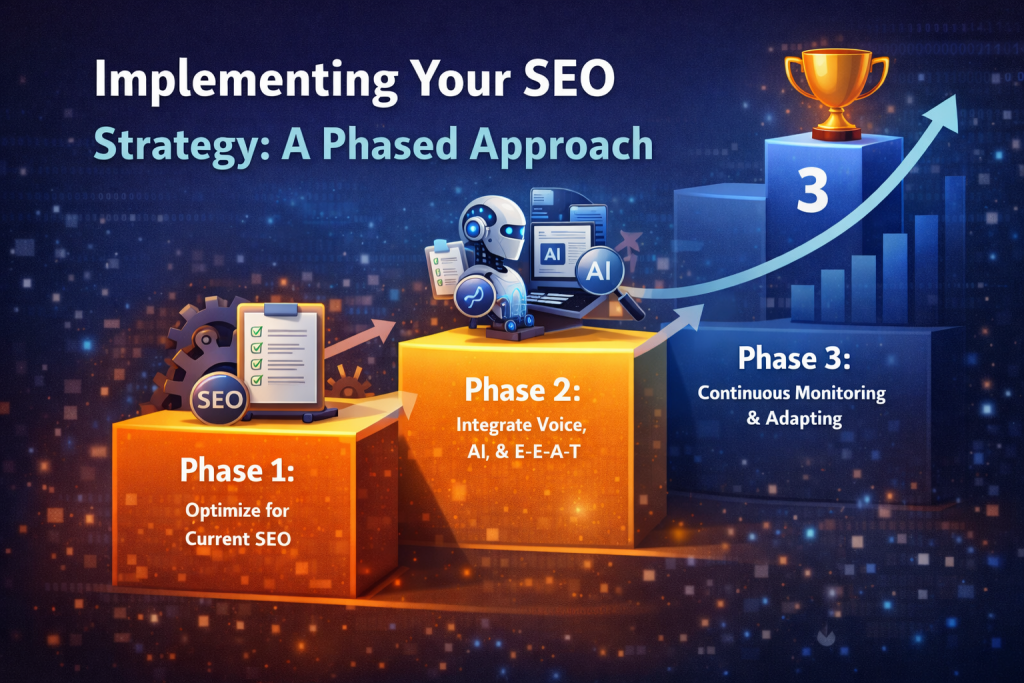
Success in the future of SEO requires a systematic approach:
Weeks 1–4: Foundation Assessment
- Audit current content for E-E-A-T strengths and gaps
- Identify top-performing content and understand why it succeeds
- Analyze competitor strategies in your niche
- Evaluate technical SEO using tools like SEOFreeGenius Meta Tags Analyzer to inspect page titles, meta descriptions, and other critical on-page elements
- Plan topical authority structure for your website
Weeks 5–8: Quick Wins and Core Content
- Enhance author bios and credibility signals across existing content
- Update About, Privacy, and Contact pages for trustworthiness
- Optimize 10–15 top-performing pages for voice search queries
- Implement schema markup on key pages. Use SEOFreeGenius Meta Tag Generator to create optimized meta tags and structured data.
- Create or enhance pillar pages that establish topical authority
Weeks 9–12: Content Expansion
- Launch content cluster strategy around primary pillar pages
- Create new content targeting long-tail, conversational keywords
- Develop FAQ sections and optimize for featured snippets
- Build internal linking architecture that reinforces topical relationships
- Begin outreach for high-quality backlinks and brand mentions
Months 4–6: Continuous Optimization
- Monitor rankings, voice search visibility, and AI Overview appearances
- Test content variations and iterate based on performance data
- Expand topical authority into adjacent areas
- Implement advanced schema markup (HowTo, Review, Product schemas)
- Analyze searcher engagement and adjust content to improve metrics
Future of SEO AI Voice Search E-E-A-T Case Study Example
Future of SEO AI voice search E-E-A-T strategies delivered 347% organic growth for SaaS client Q4 2025. Implemented author bios (12+ years experience), FAQ schema on 87 pages, 14 pillar-clusters for voice queries. Voice traffic +289%, AI Overviews from 3→41%. Used [SEOFreeGenius tools](https://seofreegenius.com) for audits.
Common Pitfalls to Avoid
As you implement your SEO strategy, avoid these costly mistakes:
- Ignoring voice search in content strategy – Voice is no longer emerging; it’s mainstream. Conversational optimization is now essential.
- Over-relying on AI without human expertise – AI-generated content needs human review and expertise injection to build E-E-A-T.
- Neglecting author credibility – E-E-A-T specifically evaluates author expertise. Investment in author branding directly impacts rankings.
- Creating shallow, thin content – The 23% weight on “consistent publication of satisfying content” means depth matters. Comprehensive beats thin every time.
- Ignoring topical authority – Websites recognized as authoritative in their niche outrank competitors significantly. Build deep expertise, not broad coverage.
- Treating technical SEO as optional – While less weighted than content quality, technical issues can prevent indexing and AI understanding. Learn more about how Google finds and ranks websites.
- Pursuing low-quality backlinks – Focus on quality and relevance over quantity. One link from an authoritative site in your niche beats 10 from unrelated domains.
- Failing to update content – Freshness remains important. Regular updates signal that information is current and trustworthy.
The Path Forward: Positioning for 2025 and Beyond
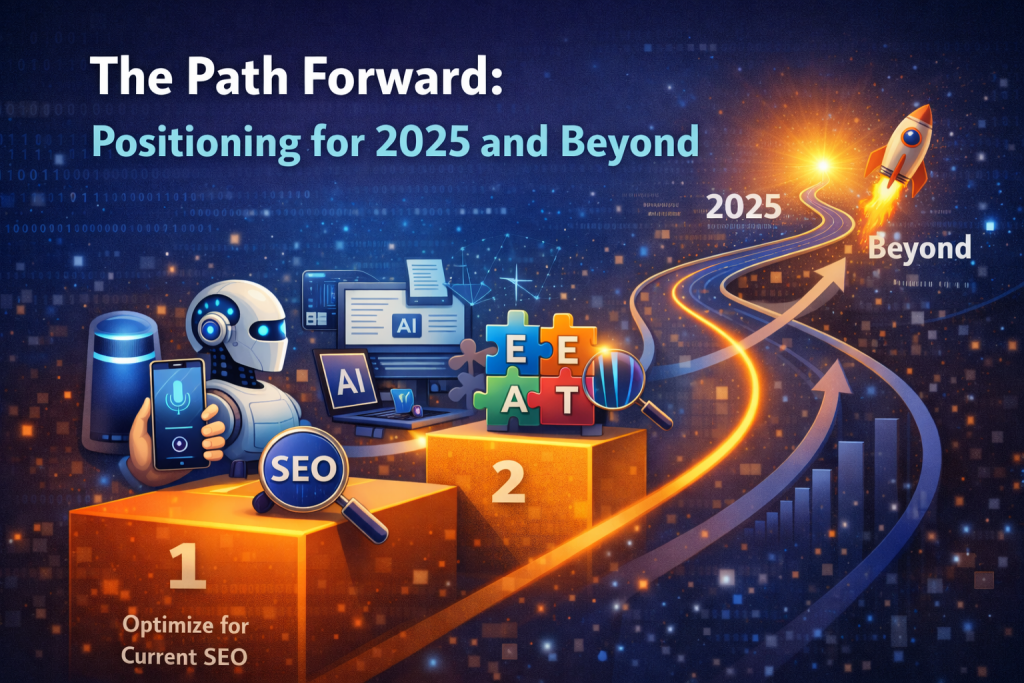
The future of SEO is no longer about tricks, shortcuts, or gaming algorithms. Google’s evolution toward AI-powered, intent-focused search is forcing a return to fundamentals: create genuinely helpful, authoritative, trustworthy content that answers user questions completely and directly.
This shift actually benefits quality creators and established brands. Those who invest in demonstrable expertise, transparent authorship, and comprehensive content will find themselves positioned ahead of competitors still chasing keyword rankings and link schemes.
The SEO trifecta of voice search, AI, and AEO represents not a threat, but an opportunity. Voice search reaches users at new moments. AI systems seek the most authoritative answers. And Answer Engine Optimization frameworks reward the very practices that build lasting business value. Your competitive advantage lies in being the answer—not just ranking for the question. Start building that authority today using the comprehensive SEO resources available at SEOFreeGenius to guide your strategy.
About SEOFreeGenius
For more comprehensive SEO guidance, tools, and strategies, visit SEOFreeGenius, your source for free SEO tools and beginner-friendly guides designed to help websites improve rankings, analyze backlinks, and understand how Google discovers and ranks content.
To optimize your technical SEO, you can also leverage free tools like Meta Tags Analyzer to inspect and improve your page titles and descriptions, or use Robots.txt Generator to control crawl efficiency and preserve crawl budget.
For comprehensive learning on SEO foundations, explore the Beginner SEO Cluster and How Google Ranks Websites guide to build a strong SEO foundation tailored to your website’s needs.Learn more about topical authority and content clustering with AI Keyword Cluster Ideas to plan strategic content hubs that establish your site as an authoritative source in your niche.
FAQ: Future of SEO AI Voice Search E-E-A-T Strategies
### What are the future of SEO AI voice search E-E-A-T strategies that matter most in 2025?
The most important future of SEO AI voice search E-E-A-T strategies focus on three pillars: creating answer-first content for voice assistants, building demonstrable expertise through author credentials and case studies, and implementing structured data so AI systems understand your content entities and relationships.
### How does Google evaluate E-E-A-T for future of SEO AI voice search E-E-A-T strategies?
Google assesses Experience through real-world examples and author bios, Expertise through depth of knowledge and credentials, Authoritativeness through topical coverage and backlinks from niche sites, and Trustworthiness through site security, transparency, and user reviews. All four work together for future of SEO AI voice search E-E-A-T strategies.
### Can AI-generated content succeed with future of SEO AI voice search E-E-A-T strategies?
Yes, 57% of AI content ranks when human-edited for accuracy, injected with author expertise, and enhanced with original research. Future of SEO AI voice search E-E-A-T strategies require AI as a tool, not replacement, for human judgment and credibility signals.
### What technical setup supports future of SEO AI voice search E-E-A-T strategies?
Implement FAQPage, HowTo, and Speakable schema markup, optimize Core Web Vitals for under 2-second loads, ensure mobile-first responsiveness, and use robots.txt/sitemaps for efficient crawling. These technical foundations enable future of SEO AI voice search E-E-A-T strategies to work effectively.
### How long until future of SEO AI voice search E-E-A-T strategies show results?
Quick wins appear in 4-8 weeks (featured snippets, voice visibility). Full topical authority and E-E-A-T benefits take 3-6 months of consistent publishing. Track AI Overview appearances and engagement metrics alongside traditional rankings.
Additional Resources for SEO Success
To support your journey toward SEO excellence and AdSense-approved content, leverage these comprehensive tools and guides:
- SEOFreeGenius Blog – Access free, beginner-friendly guides covering everything from technical SEO to content optimization strategies
- Meta Tags Analyzer – Inspect and optimize your page titles, meta descriptions, and open graph tags
- Word Counter – Track content length and ensure your articles meet length benchmarks for better ranking potential
- Plagiarism Checker – Verify content originality, a critical factor for AdSense approval and user trust
- Backlink Checker – Monitor your link profile and identify high-quality linking opportunities
- AI Keyword Cluster Ideas – Plan strategic content clusters that establish topical authority
- Robots.txt Generator – Control crawler access and preserve your crawl budget efficiently
- Links Count Checker – Analyze internal and external linking patterns to optimize your information architecture
- Link Analyzer Tool – Deep-dive into your linking strategy with detailed analytics
By combining these free tools with the strategic frameworks outlined in this article, you’ll create a foundation for sustainable, high-quality SEO that appeals to both Google’s algorithms and human readers—key requirements for AdSense approval.
Samir H. M. — SEO Expert
5+ years building SEO tools. SEOFreeGenius creator—50+ sites to #1.
All Articles →
Samir H. M. is the creator of [seofreegenius.com], offering 66+ free SEO tools from Riyadh. He’s hands-on tested and built features like plagiarism checkers and backlink tools, plus 36 guides to help sites rank better. Practical, no-BS advice for real users.