
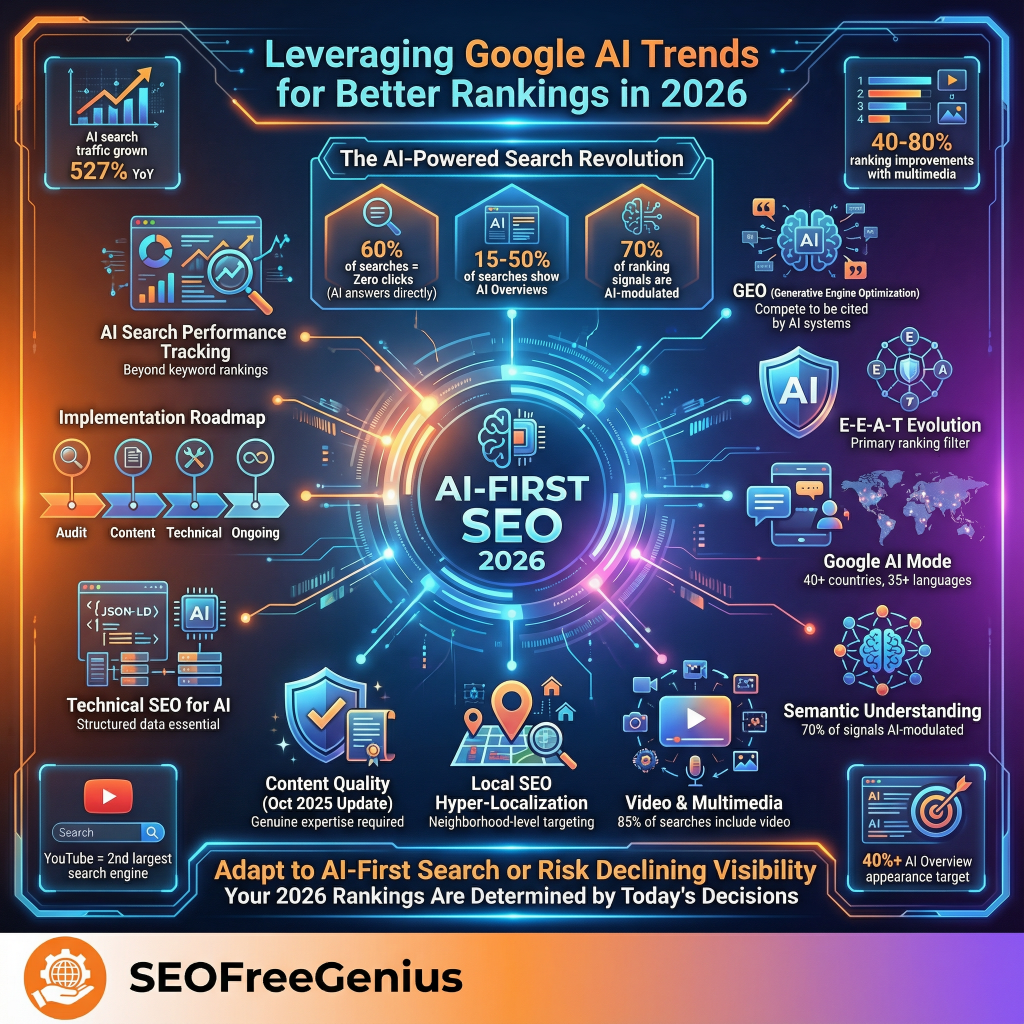
Introduction: The AI-Powered Search Revolution
The search landscape has fundamentally transformed. In 2026, Google’s search engine has evolved from a keyword-matching tool into an intelligent, AI-driven answer engine that understands context, intent, and nuance at unprecedented scale. This shift is not gradual—it’s revolutionary.
The Numbers Tell the Story: Approximately 60% of searches now generate zero clicks because Google’s AI provides comprehensive answers directly on the search results page. Meanwhile, Google AI Overviews now appear in 15-50% of all searches, fundamentally changing how users discover information and how content creators must optimize their strategies.
For digital marketers and content creators, this transformation presents a critical challenge: adapt to AI-driven search optimization, or risk declining visibility and traffic. The old SEO playbook—where keyword density and backlink count ruled rankings—is obsolete. Today’s ranking landscape is dominated by Experience, Expertise, Authoritativeness, and Trustworthiness (E-E-A-T) signals evaluated through advanced AI systems. This comprehensive guide explores the most important Google AI trends shaping SEO in 2026 and provides actionable strategies to help your content rank higher, appear in AI-generated summaries, and attract qualified organic traffic. Whether you’re managing an established brand or scaling a startup, these proven strategies will position your content for success in the AI-first search era.
1. Generative Engine Optimization (GEO): The New Ranking Battleground
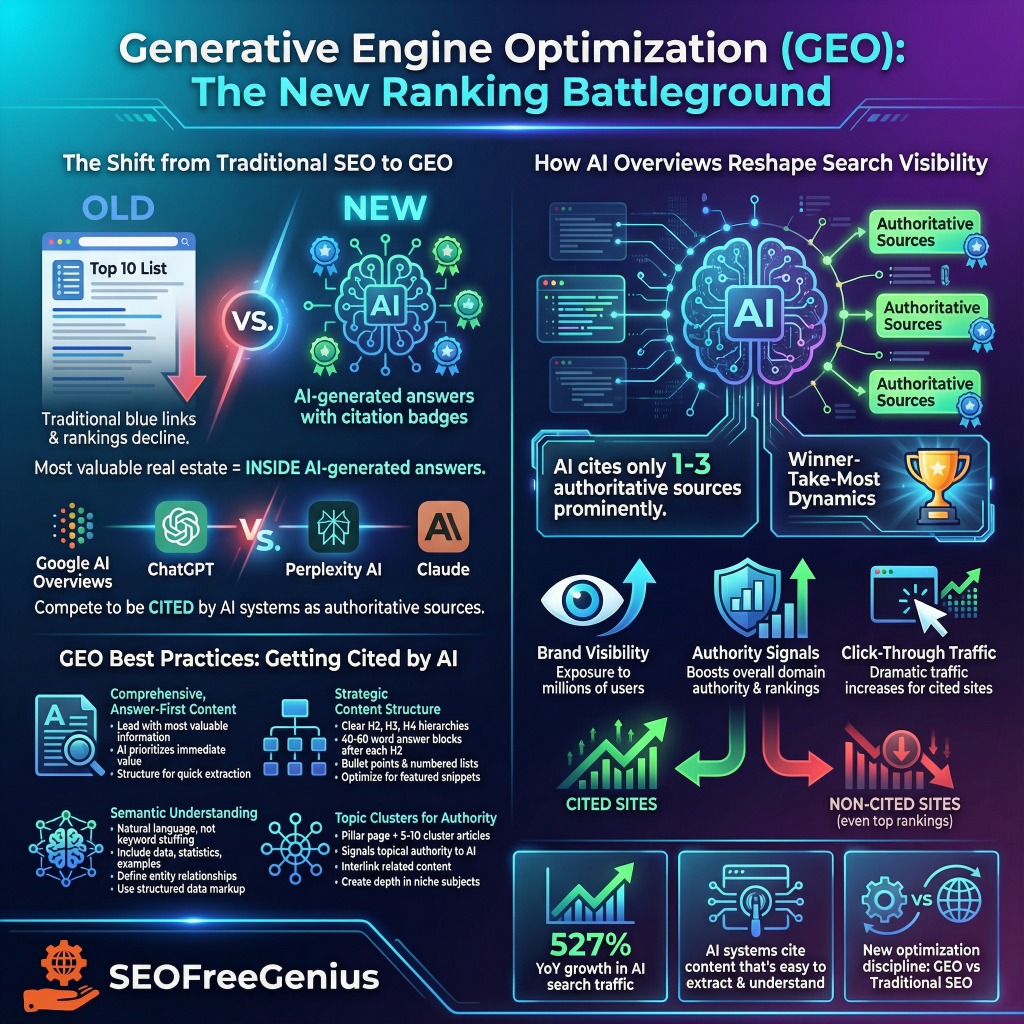
Understanding the Shift from Traditional SEO to GEO
Traditional SEO focused on securing positions in the top 10 blue links on Google’s search results page. However, in 2026, the most valuable real estate is inside AI-generated answers. Google AI Overviews, ChatGPT search results, Perplexity AI responses, and Claude research capabilities are now answering user queries directly—often without requiring any click to external websites.
This fundamental shift has created a new optimization discipline called Generative Engine Optimization (GEO). Rather than competing for the tenth position in organic search, modern marketers now compete to be cited by AI systems as authoritative, trustworthy sources. Being featured in an AI-generated summary provides several distinct advantages: it increases brand visibility to millions of AI users, establishes authority signals that boost traditional search rankings, and creates opportunities for click-through traffic from users interested in deeper analysis.
How AI Overviews Are Reshaping Search Visibility
Google AI Overviews fundamentally change search result economics. When Google’s AI generates an overview, it typically cites only 1-3 authoritative sources prominently, with additional sources hidden behind a “Show all” interface. This concentrated citation model creates winner-take-most dynamics: websites appearing in AI Overviews experience dramatic traffic increases, while sites not cited see traffic declines—even if they previously ranked in positions 1-3 of traditional organic results.
The strategic implication is clear: content that Google’s AI systems can easily extract, understand, and cite as an authority now directly impacts search visibility and traffic. This requires a different approach to content structure, formatting, and presentation than traditional SEO optimization alone.
GEO Best Practices: Getting Cited by AI Systems
To optimize for AI citation and maximize your visibility in AI-generated answers, implement these proven strategies:
Create Comprehensive, Answer-First Content: Structure your content to directly answer user questions in the opening paragraphs. Rather than burying the key insight in your conclusion, lead with the most valuable, actionable information. AI systems prioritize content that delivers immediate value. For detailed GEO implementation strategies, see the comprehensive resources available through platforms like Averi’s AI Overview optimization framework, which provides proven 90-day implementation roadmaps.
Implement Strategic Content Structure: Use clear heading hierarchies (H2, H3, H4) that mirror common questions your audience asks. AI systems parse content structure to understand key topics and concepts. Break complex ideas into scannable sections with bullet points and numbered lists. Include 40-60 word answer blocks immediately after each H2 heading—this format makes it easy for AI systems to extract your most important insights.
Optimize for Semantic Understanding: Rather than keyword stuffing, use natural language and conversational tone that matches how AI systems parse meaning. Include specific data, statistics, and examples that AI can extract and present in summaries. Define entity relationships clearly, explaining how concepts connect to each other. For advanced semantic optimization techniques, consult resources like OMNIUS’s comprehensive AI Overviews ranking guide, which details 8 proven methods for securing AI citation.
Don’t guess which words AI prefers. Use our [Keywords Suggestion Tool] to find semantically related terms that help bots understand your context.
Build Topic Clusters for Authority: Create interconnected content clusters around core topics. A pillar page covering a broad topic should be supported by cluster content addressing specific subtopics, questions, and implementation details. This structure signals topical authority to AI systems, making your content more likely to be cited across multiple related queries. Learn more about advanced GEO strategies by visiting your complete beginner SEO cluster guide. Industry leaders like Semrush track AI search trend metrics showing how AI search traffic has grown 527% year-over-year, demonstrating the critical importance of GEO optimization.
Building clusters is hard work. Automate the process with our [AI Keyword Cluster Ideas] tool to find perfect groupings in seconds
2. E-E-A-T Evolution: Why Expertise and Trust Are Critical in 2026
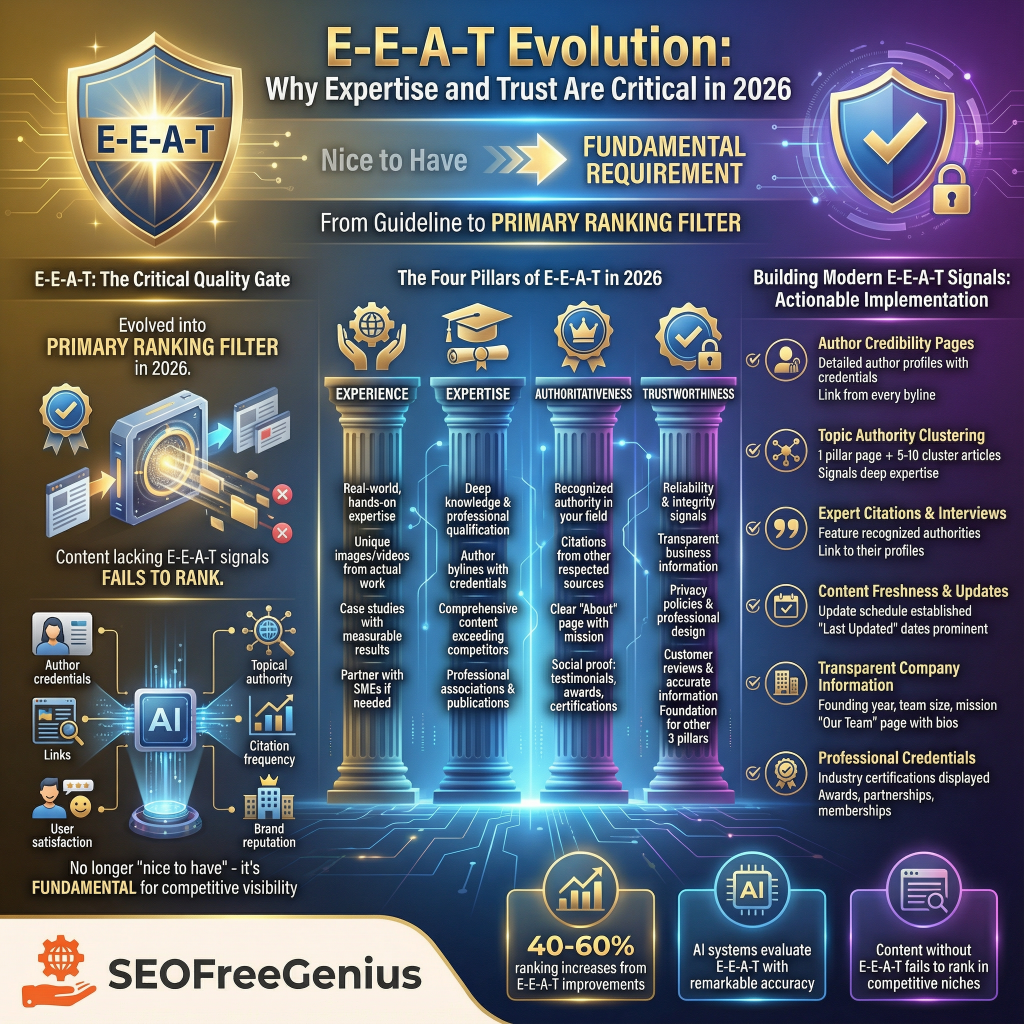
E-E-A-T Transitions from Guideline to Primary Ranking Filter
In Google’s early quality rater guidelines, E-E-A-T (Experience, Expertise, Authoritativeness, and Trustworthiness) served as an evaluation framework for human raters assessing search quality. In 2026, E-E-A-T has evolved into a primary ranking filter that functions as a critical quality gate. Content lacking clear E-E-A-T signals increasingly fails to rank in competitive niches, regardless of technical optimization or keyword targeting precision.
Google now uses AI systems to identify and evaluate E-E-A-T signals with remarkable accuracy. Unlike previous algorithm generations, modern AI can analyze author credentials, topical authority patterns, citation frequency, user satisfaction signals, and brand reputation at scale. This means E-E-A-T is no longer a “nice to have” quality signal—it’s a fundamental requirement for competitive visibility.
The Four Pillars of E-E-A-T in 2026
Experience: Demonstrate real-world, hands-on expertise in your field. This goes beyond theoretical knowledge. Include unique images and videos from your actual work, share specific case studies with measurable results, and include anecdotes that only someone actively practicing in your field could know. For content creators without direct experience, partner with subject matter experts (SMEs) and clearly credit their involvement. Your experience signals tell Google that your guidance comes from someone who has actually implemented the strategies you’re recommending.
Expertise: Provide evidence of deep knowledge and professional qualification. Include author bylines with detailed credentials—education, certifications, years of relevant experience, and published work. Create comprehensive content that goes significantly deeper than competitors, covering nuances and edge cases that demonstrate mastery. Link to your professional association memberships, published articles, and speaking engagements. For business content, feature team members with relevant qualifications and highlight their industry recognition.
Authoritativeness: Establish your brand as a recognized authority in your field. This happens through a combination of consistent, high-quality content; recognition from other authoritative sources; and clear topical focus. Build citation patterns where other respected organizations reference and link to your work. Develop a clear “about” page that explicitly communicates your company mission, team expertise, and industry credibility. Include social proof like testimonials, case study results, awards, and industry certifications.
Trustworthiness: Ensure every element of your website communicates reliability and integrity. This includes transparent business information (physical address, phone number, contact information), clear privacy and security policies, professional site design, and accurate information. Maintain consistent brand information across all platforms. Encourage and respond to customer reviews. For sensitive topics (health, finance, legal), include disclaimers that appropriate. Trustworthiness is the foundation that makes the other three E-E-A-T pillars credible.
Building Modern E-E-A-T Signals: Actionable Implementation
Strengthen your E-E-A-T signals through these specific, measurable actions:
- Author Credibility Pages: Create detailed author profile pages for every primary content creator. Include their background, education, certifications, years in the industry, previous publications, and social media profiles (especially LinkedIn). Link to these profiles from every byline.
- Topic Authority Clustering: Organize your content into clusters around core expertise areas. One “pillar” page should cover a topic comprehensively, supported by 5-10 cluster articles addressing specific subtopics. This structure signals deep expertise to Google’s algorithms.
- Expert Citations and Interviews: Feature quotes from and interviews with recognized authorities in your field. Link to their professional profiles and publications. This association signals that other experts recognize your credibility.
- Content Freshness and Updates: Establish a content update schedule. Keep important evergreen content current with new data, recent developments, and up-to-date statistics. Include “Last Updated” dates prominently. Google’s algorithms recognize fresh, continuously-improving content as more trustworthy.
- Transparent Company Information: Prominently feature company details—founding year, team size, mission statement, office location, and leadership backgrounds. Create an “Our Team” page with detailed bios. This transparency builds trust.
- Professional Credentials and Certifications: Display relevant industry certifications, awards, partnerships, and professional memberships. If your team members hold certifications (CISSP, AWS Certified, etc.), highlight these prominently.
Apply the E-E-A-T evolution principles detailed in this article’s roadmap to build expertise, experience, authoritativeness, and trust signals. Industry experts at Search Engine Journal explain how E-E-A-T impacts modern search, with case studies showing how improvements drove 40-60% ranking increases for competitive terms.
3. Google AI Mode: Optimizing for Conversational Search
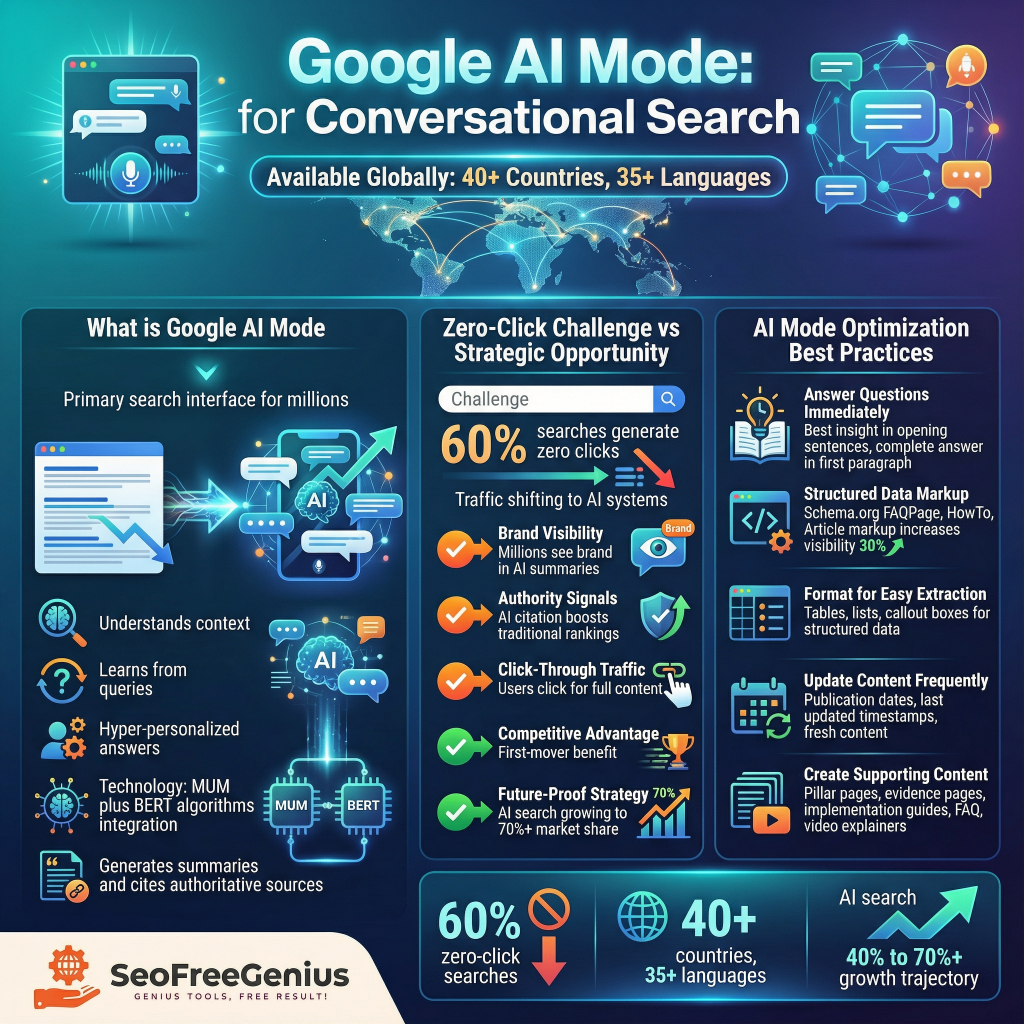
What is Google AI Mode and Why It Matters
In 2026, Google AI Mode is now available globally in 40+ countries and 35+ languages, representing a fundamental shift in how billions of users discover information. Rather than scrolling through 10 blue links, users increasingly engage with conversational AI that understands context, learns from previous queries, and provides hyper-personalized answers.
Google AI Mode has moved beyond a testing phase to become a primary search interface for millions of users. The technology integrates Google’s MUM (Multitask Unified Model) and BERT algorithms to understand complex queries, generate comprehensive summaries, and cite multiple authoritative sources within conversational responses.
The Zero-Click Problem and Strategic Opportunities
The Challenge: AI Mode can answer 60% of searches without users ever clicking through to any website. This creates the “zero-click problem”—search traffic potentially shifts from traditional organic results to AI systems. However, the most sophisticated marketers recognize this as an opportunity, not a threat.
The Strategic Opportunity: Rather than fighting AI search, the smartest brands optimize to be cited by it. When AI systems cite your content, you gain:
- Brand Visibility: Millions of AI users see your brand mentioned in AI-generated summaries
- Authority Signals: AI citation reinforces authority signals that boost traditional search rankings
- Click-Through Traffic: Users interested in your complete analysis will click to read the full content
- Competitive Advantage: Most competitors haven’t optimized for AI Mode, creating a first-mover advantage
- Future-Proof Strategy: As AI search grows from 40% to 70%+ of total search, AI optimization becomes essential
AI Mode Optimization Best Practices
Answer User Questions Immediately: Place your best insight in the opening 2-3 sentences. Don’t make AI systems or users hunt for your key point. The first paragraph should contain a complete, standalone answer to the user’s query.
Implement Structured Data Markup: Add Schema.org markup (FAQPage, HowTo, Article, NewsArticle) to help AI systems parse and understand your content structure. Structured data increases AI visibility by up to 30%. Use JSON-LD format for implementation.
Format for Easy Extraction: Use tables, lists, and callout boxes for key information. AI systems can more easily extract and present structured data than body copy. A well-organized table or comparison matrix is more likely to appear in AI-generated summaries than paragraph text conveying the same information.
Update Content Frequently: Include publication dates and “last updated” timestamps. Keep content current with latest statistics, recent developments, and timely examples. AI systems recognize fresh, continuously-updated content as more authoritative and reliable.
Create Supporting Content: Develop comprehensive answer kits around your most important topics. This includes a main pillar page, supporting evidence pages, implementation guides, FAQ compilations with schema markup, and video explainers. These interconnected content pieces reinforce each other’s authority. For detailed analysis of AI Mode’s impact on search behavior, see Google’s official AI in Search announcement.
4. Semantic Understanding: Moving Beyond Keyword Matching
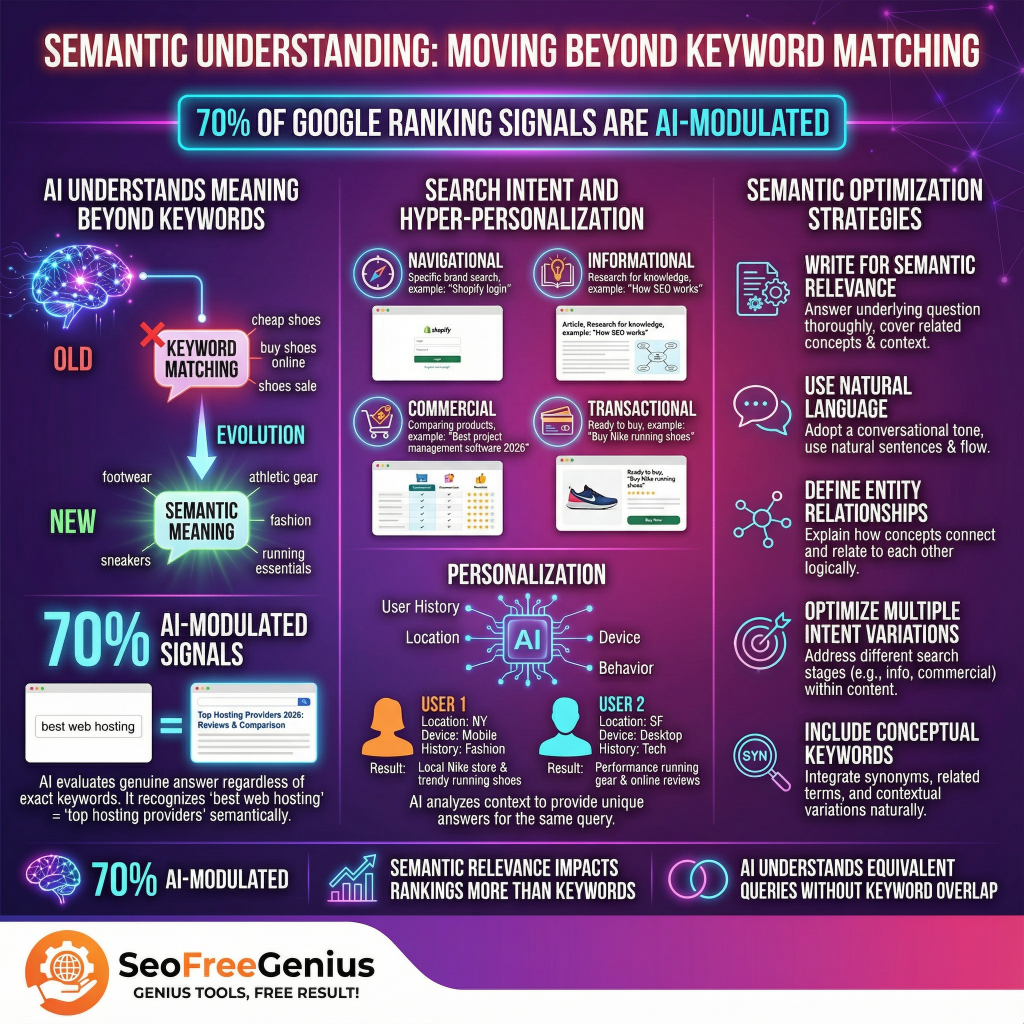
How AI Systems Understand Meaning Beyond Keywords
In traditional SEO, matching target keywords in title tags, headings, and body copy was paramount. Modern AI algorithms—powered by sophisticated neural networks and large language models—understand the semantic meaning of your content at a level keywords alone cannot capture.
Over 70% of Google’s ranking signals are now AI-modulated, meaning artificial intelligence evaluates whether your content genuinely answers the user’s underlying question, regardless of exact keyword matches. This represents a fundamental shift in how search engines evaluate relevance. An article about “best web hosting” and “top 3 hosting providers” might rank identically because AI understands they’re semantically equivalent queries, even without keyword overlap.
Search Intent Variations and Hyper-Personalization
Google’s AI systems now interpret search query variations and understand subtle differences in user intent. A single search term can have multiple valid interpretations:
- Navigational Intent: User searching for a specific brand or website (e.g., “Shopify login”)
- Informational Intent: User researching a topic for knowledge or education (e.g., “how does SEO work”)
- Commercial Intent: User comparing products before making a purchase decision (e.g., “best project management software 2026”)
- Transactional Intent: User ready to buy or complete a specific action (e.g., “buy Nike running shoes online”)
Beyond intent, Google’s algorithms personalize results based on user history, geographic location, device type, and implicit signals about their needs and preferences. Two users asking virtually identical questions may receive dramatically different answers based on their unique context.
This personalization is powered by AI analysis of user behavior patterns, search history, browsing habits, and contextual signals. It means that ranking for a keyword is no longer a binary outcome—your visibility varies based on user characteristics, search context, and personalization algorithms.
Semantic Optimization Strategies
Write for Semantic Relevance: Focus on thoroughly answering the user’s underlying question rather than simply matching keywords. Cover the topic comprehensively, addressing related concepts, edge cases, and nuances. If you’re writing about “SEO for e-commerce,” cover product page optimization, category page strategy, technical SEO considerations, link building for e-commerce, and competitive analysis—not just keyword density.
Use Natural Language: Write how humans actually communicate, not how keyword research tools suggest. Use conversational tone, complete sentences, and natural word order. If you’re forcing keywords into unnatural sentences, AI systems will penalize the artificial structure.
Define Entity Relationships: Clearly explain how concepts relate to each other. Instead of just mentioning related topics, explicitly define their relationships. For example: “Core Web Vitals, which include Largest Contentful Paint (LCP), First Input Delay (FID), and Cumulative Layout Shift (CLS), are the three metrics Google uses to evaluate page experience.”
Optimize for Multiple Intent Variations: Create content addressing different stages of the search journey. Someone searching “what is SEO” has different intent than someone searching “best SEO tools 2026.” Both are valid, and addressing both intents with targeted content increases your total search visibility.
Include Conceptual Keywords: Use synonyms, related terms, and contextual variations throughout your content. If discussing “machine learning,” also mention “artificial intelligence,” “neural networks,” and “predictive models” where semantically appropriate. This helps AI systems understand the breadth of your expertise. Research from Software Rix on AI ranking factors shows that semantic relevance now impacts rankings more than exact keyword matching.
5. Video and Multimedia: The Multi-Modal Search Imperative
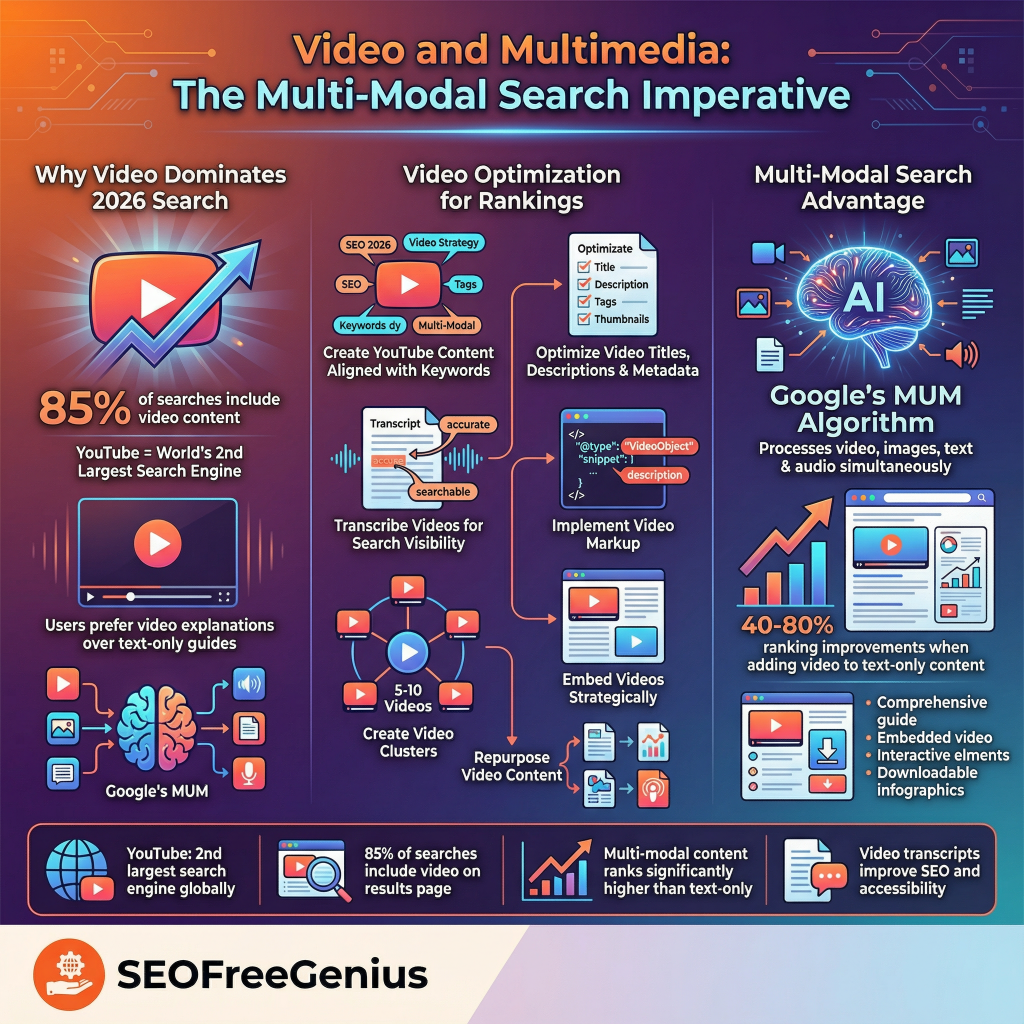
Why Video Dominates 2026 Search Results
YouTube is now the world’s second-largest search engine, and video content increasingly dominates Google’s organic search results. In 2026, approximately 85% of searches include video content on the results page, and users actively prefer video explanations over text-only guides.
Google’s MUM algorithm represents a watershed moment in search technology: it processes video, images, text, and audio simultaneously, understanding connections and relationships across media types. This multi-modal understanding means multimedia content has significant ranking advantages over text-only pages. A comprehensive guide with accompanying video, infographics, and interactive elements ranks higher than a text-only version covering identical information.
Video Optimization for Search Rankings
Create YouTube Content Aligned with Keywords: Develop YouTube videos targeting your core search keywords and topic clusters. Structure video titles and descriptions for YouTube search optimization. Include timestamps for different sections, which helps both YouTube and Google understand your content structure.
Optimize Video Titles, Descriptions, and Metadata: Use target keywords naturally in video titles (keep under 60 characters). Write detailed descriptions (200+ words) that explain video content clearly. Include timestamps marking key sections. Add relevant tags for topical categorization.
Transcribe Videos for Search Visibility: Create full transcripts of video content and include them on your website pages. Google uses video transcripts for ranking and accessibility. Users also benefit—transcripts make your content accessible to deaf and hard-of-hearing audiences and improve content SEO. Many CMSs and platforms (like Rev, Otter.ai) provide affordable transcription services.
Implement Video Markup: Use VideoObject schema markup to help Google understand and index your video content. Include video title, description, duration, publication date, and thumbnail image in your markup. This helps Google display your videos in rich snippets and video carousels.
Create Video Clusters: Develop multiple videos around core topics to build topical authority. A pillar topic might have 5-10 supporting videos addressing different aspects. This interconnected video strategy signals deep expertise.
Embed Videos Strategically: Include relevant YouTube videos on your website pages with contextual text explaining why the video is valuable. Include video title and description immediately around the embed. This combination of video, text, and context ranks better than video alone.
Repurpose Video Content: Transform video content into blog posts, infographics, social media clips, and email content. This multi-format approach increases total reach and provides multiple entry points for search traffic. A 10-minute video can become a 2,000-word blog post, 5 social media clips, and an infographic. Search Engine Journal’s 2026 video SEO trends provide detailed case studies showing 40-80% ranking improvements when adding video to text-only content.
6. Local SEO in 2026: Hyper-Localization and Neighborhood Dominance
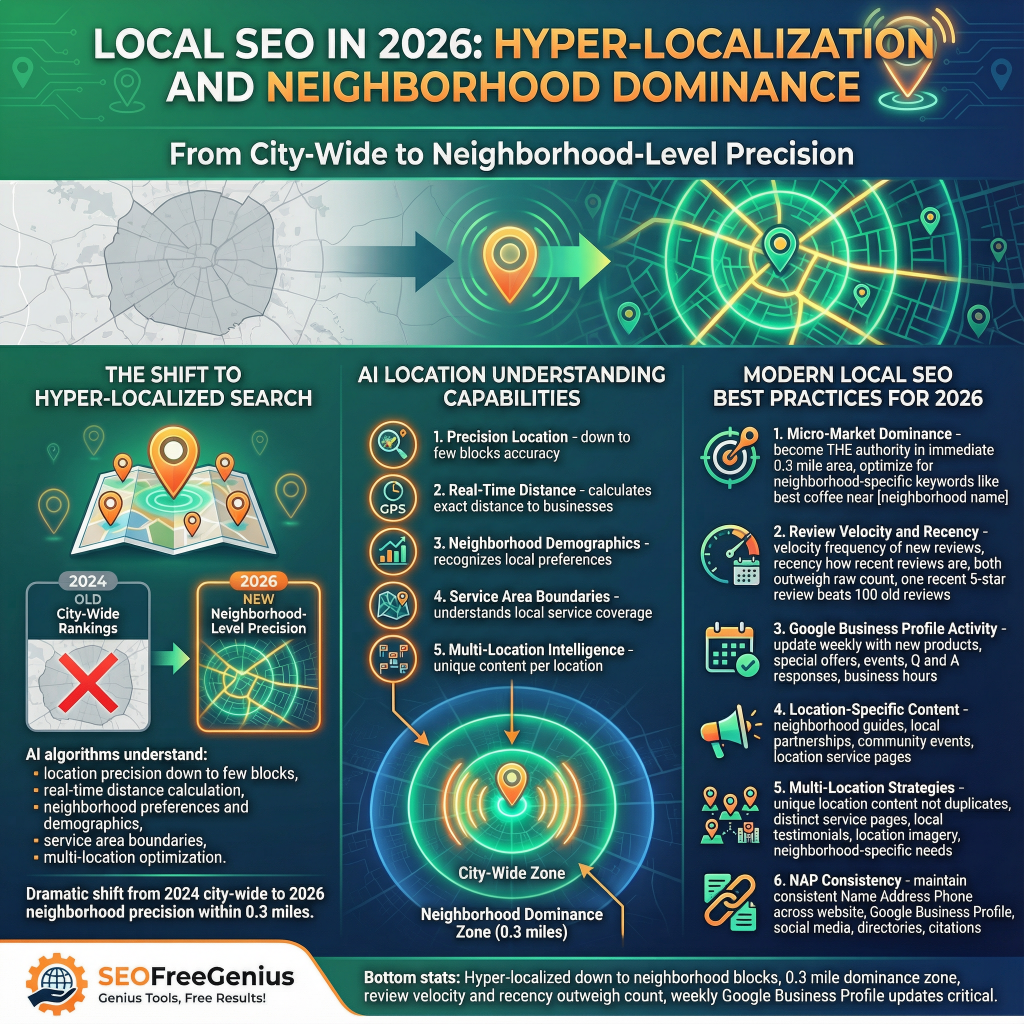
The Shift to Hyper-Localized Search Results
Local SEO has become hyper-localized in 2026. Google increasingly favors businesses within extremely close proximity to searchers, often down to neighborhood-level precision rather than city-wide rankings. This represents a dramatic shift from even 2024, when “local” meant city-wide or regional visibility.
AI algorithms now understand user location with precision down to a few blocks, calculate real-time distances to businesses, recognize neighborhood preferences and demographics, understand service area boundaries for local service businesses, and optimize for multi-location businesses with unique content for each location.
Modern Local SEO Best Practices for 2026
Focus on Micro-Market Dominance: Rather than striving for top-3 city-wide rankings, focus on becoming THE authority in your immediate geographic area. A restaurant that dominates search results within 0.3 miles will outperform a competitor with city-wide rankings. Optimize for highly specific local keywords: “best coffee near [neighborhood name]” rather than “best coffee in [city].”
Prioritize Review Velocity and Recency: While total review count still matters, review velocity (frequency of new reviews) and recency (how recent reviews are) now outweigh raw count. One recent 5-star review signals more current business excellence than 100 reviews from 2-3 years ago. Encourage satisfied customers to leave reviews immediately after positive interactions.
Optimize Google Business Profile Activity: Regular posts, Q&A responses, and profile updates send strong ranking signals to Google. Update your Google Business Profile at least weekly with:
- New products or services
- Special offers or promotions
- Event announcements
- Answers to common customer questions
- Updated business hours or service information
Create Location-Specific Content: Develop content targeting neighborhood-specific keywords. Write guides for your specific neighborhoods, highlight local partnerships, create content about local events or community involvement, and develop location-specific service pages.
Implement Multi-Location Strategies: If you operate multiple locations, each should have:
- Unique, location-specific content (not keyword-stuffed duplicates)
- Distinct service pages highlighting location-specific offerings
- Local case studies or testimonials from that location’s customers
- Location-specific imagery (interior photos, team photos from that office)
- Neighborhood-specific content addressing local customer needs
Ensure NAP Consistency: Maintain consistent Name, Address, and Phone number (NAP) information across all platforms—your website, Google Business Profile, social media, local directories, and citation sources. Inconsistency directly impacts local search visibility. Impression Digital’s algorithm tracking monitors how local ranking factors evolve quarterly, providing insights into emerging local SEO opportunities.
7. Content Quality: The October 2025 Update and Ongoing Implications
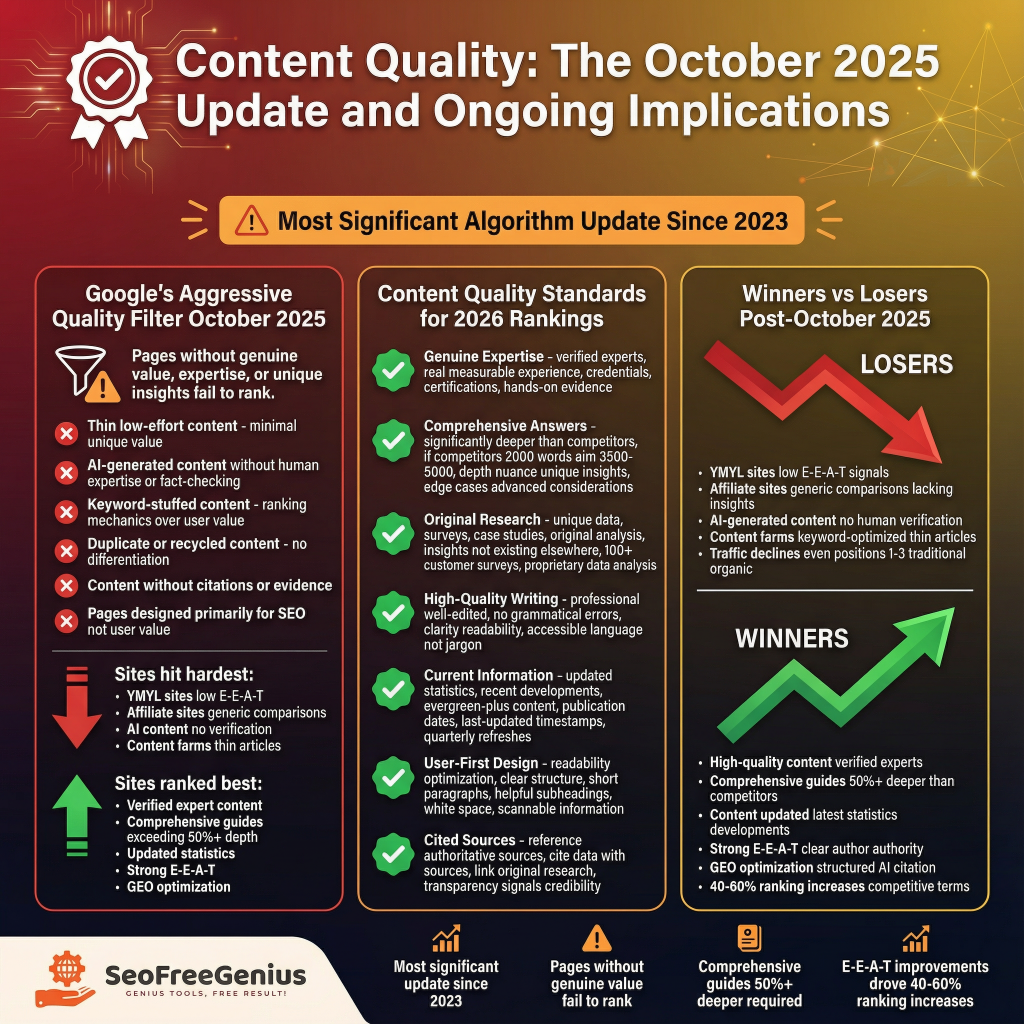
Google’s Aggressive Quality Filter: The October 2025 Update
In October 2025, Google deployed one of its most significant algorithm updates since 2023. The October changes represent Google’s aggressive commitment to eliminating thin, low-effort content from competitive search results. Pages without genuine value, expertise, or unique insights increasingly fail to rank in competitive niches, even if they technically target popular keywords and follow traditional SEO best practices.
The algorithm now aggressively filters and demotes:
- Thin, low-effort content with minimal unique value or depth
- AI-generated content without human expertise or fact-checking
- Keyword-stuffed content that prioritizes ranking mechanics over user value
- Duplicate or recycled content appearing on multiple sites without differentiation
- Content without citations or evidence supporting factual claims
- Pages designed primarily for SEO rather than user value and information quality
Sites hit hardest by the October 2025 update included YMYL (Your Money Your Life) sites with low E-E-A-T signals, affiliate sites with generic comparisons lacking unique insights, AI-generated content without human expertise verification, and content farms publishing keyword-optimized but thin articles.
Sites that ranked best after October 2025 shared common characteristics: high-quality content from verified experts, comprehensive guides exceeding competitor depth by 50%+, content updated with latest statistics and recent developments, strong E-E-A-T signals with clear author authority, and GEO optimization ensuring content was structured for AI citation.
Content Quality Standards for 2026 Rankings
To rank competitively in 2026, your content must demonstrate:
Genuine Expertise: Content must be authored by verified experts with real, measurable experience in the topic. Include credentials, certifications, and evidence of hands-on expertise. If you lack expertise, partner with subject matter experts and clearly credit their involvement.
Comprehensive Answers: Go significantly deeper than competitors. If competitors average 2,000 words, aim for 3,500-5,000 words with substantially more depth, nuance, and unique insights. Cover edge cases, advanced considerations, and detailed implementations that casual coverage misses.
Original Research: Include unique data, surveys, case studies, original analysis, or insights that don’t exist elsewhere. Original research might involve surveying 100+ customers, analyzing proprietary data, conducting original experiments, or performing unique comparative analysis.
High-Quality Writing: Professional, well-edited content without grammatical errors, spelling mistakes, or awkward phrasing. Clarity and readability matter—complex ideas should be explained in accessible language, not dense jargon.
Current Information: Updated statistics, recent developments, and evergreen-plus content that stays current. Include publication dates and last-updated timestamps. Refresh important evergreen content quarterly with new data and recent examples.
User-First Design: Optimize for readability with clear structure, short paragraphs, helpful subheadings, white space, and visual breaks. Make important information easily scannable. Prioritize user value over keyword placement.
Cited Sources: Reference authoritative sources and link to them appropriately. Cite data with sources. Link to original research rather than secondary summaries. This transparency signals credibility and helps Google evaluate your content’s foundational quality. ClickRank’s EEAT-focused content optimization analysis explains how to structure content to pass Google’s quality filters.
8. Technical SEO for AI-First Indexing
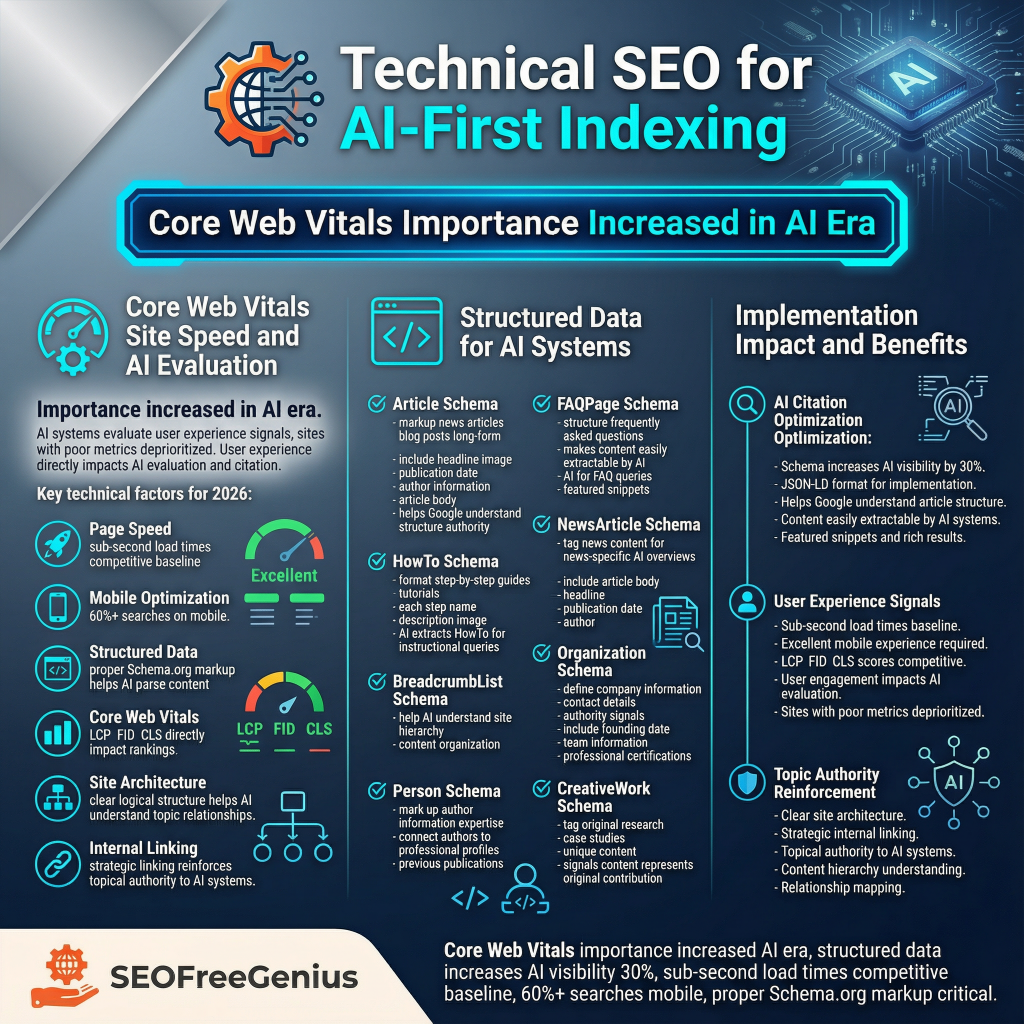
Core Web Vitals, Site Speed, and AI Evaluation
While Core Web Vitals have stabilized as ranking factors, their importance has increased in the AI era. AI systems evaluate user experience signals, and sites with poor experience metrics are deprioritized. User experience directly impacts how AI systems evaluate and cite your content.
Key technical factors for 2026 include page speed (sub-second load times are competitive baseline), mobile optimization (60%+ of searches happen on mobile), structured data (proper Schema.org markup helps AI parse your content), Core Web Vitals (LCP, FID, CLS directly impact rankings), site architecture (clear, logical structure helps AI understand topic relationships), and internal linking (strategic linking reinforces topical authority to AI systems).
Structured Data for AI Systems
Implement these Schema.org markups to optimize for AI citation:
- Article Schema: Markup news articles, blog posts, and long-form content. Include headline, image, publication date, author information, and article body. This helps Google understand your article’s structure and authority.
- FAQPage Schema: Structure frequently asked questions with schema markup. This makes your content easily extractable by AI systems for FAQ-based queries and featured snippets.
- HowTo Schema: Format step-by-step guides and tutorials. Each step should include name, description, and image if available. AI systems extract HowTo content for instructional queries.
- NewsArticle Schema: Tag news content for news-specific AI overviews. Include article body, headline, publication date, and author information.
- BreadcrumbList Schema: Help AI understand your site hierarchy and content organization.
- Organization Schema: Define company information, contact details, and authority signals. Include founding date, team information, and professional certifications.
- Person Schema: Mark up author information and expertise. Connect authors to their professional profiles and previous publications.
- CreativeWork Schema: Tag original research, case studies, and unique content. This signals that content represents original contribution.
Optimize your technical foundation with structured data, core web vitals, and AI‑ready site architecture tailored to your current SEO toolkit. For comprehensive technical optimization strategies and update coverage, consult Search Engine Land’s technical update tracking.
Remember, AI reads code first. Ensure your tags are clean and descriptive with our [Meta Tag Generator].
9. Implementation Roadmap: Your 2026 SEO Strategy
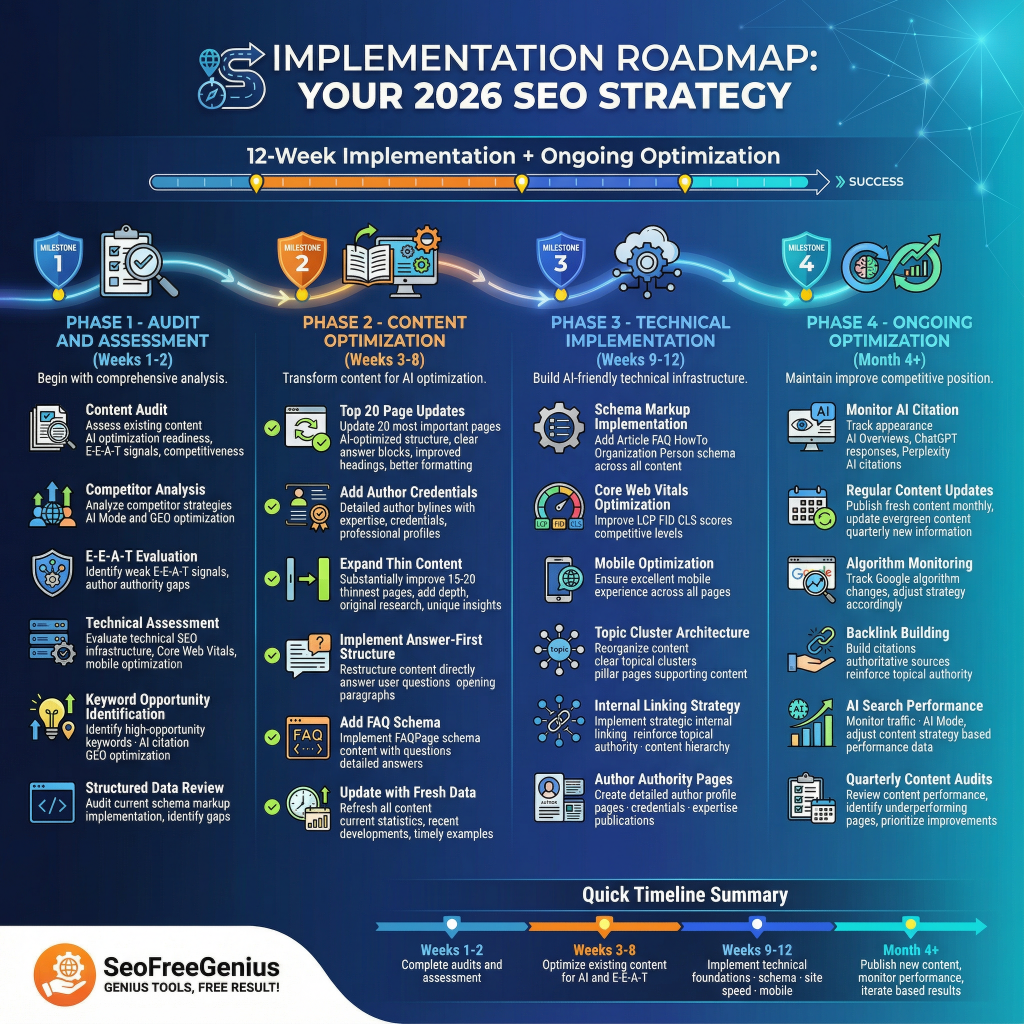
Phase 1: Audit and Assessment (Weeks 1-2)
Begin with comprehensive analysis:
- Content Audit: Assess existing content for AI optimization readiness, E-E-A-T signals, and competitiveness
- Competitor Analysis: Analyze competitor strategies in AI Mode and GEO optimization
- E-E-A-T Evaluation: Identify weak E-E-A-T signals and author authority gaps
- Technical Assessment: Evaluate technical SEO infrastructure, Core Web Vitals, and mobile optimization
- Keyword Opportunity Identification: Identify high-opportunity keywords for AI citation and GEO optimization
- Structured Data Review: Audit current schema markup implementation and identify gaps
Phase 2: Content Optimization (Weeks 3-8)
Transform your content for AI optimization:
- Top 20 Page Updates: Update your 20 most important pages with AI-optimized structure (clear answer blocks, improved headings, better formatting)
- Add Author Credentials: Include detailed author bylines with expertise, credentials, and professional profiles
- Expand Thin Content: Substantially improve your 15-20 thinnest pages by adding depth, original research, and unique insights
- Implement Answer-First Structure: Restructure content to directly answer user questions in opening paragraphs
- Add FAQ Schema: Implement FAQPage schema for content with questions and detailed answers
- Update with Fresh Data: Refresh all content with current statistics, recent developments, and timely examples
Phase 3: Technical Implementation (Weeks 9-12)
Build AI-friendly technical infrastructure:
- Schema Markup Implementation: Add Article, FAQ, HowTo, Organization, and Person schema across all content
- Core Web Vitals Optimization: Improve LCP, FID, and CLS scores to competitive levels
- Mobile Optimization: Ensure excellent mobile experience across all pages
- Topic Cluster Architecture: Reorganize content into clear topical clusters with pillar pages and supporting content
- Internal Linking Strategy: Implement strategic internal linking to reinforce topical authority and content hierarchy
- Author Authority Pages: Create detailed author profile pages with credentials, expertise, and publications
Phase 4: Ongoing Optimization (Month 4+)
Maintain and improve your competitive position:
- Monitor AI Citation: Track your appearance in AI Overviews, ChatGPT responses, and Perplexity AI citations
- Regular Content Updates: Publish fresh content monthly and update evergreen content quarterly with new information
- Algorithm Monitoring: Track Google algorithm changes and adjust strategy accordingly
- Backlink Building: Build citations from authoritative sources to reinforce topical authority
- AI Search Performance: Monitor traffic from AI Mode and adjust content strategy based on performance data
- Quarterly Content Audits: Review content performance, identify underperforming pages, and prioritize improvements
- Weeks 1-2: Complete audits and assessment
- Weeks 3-8: Optimize existing content for AI and E-E-A-T
- Weeks 9-12: Implement technical foundations (schema, site speed, mobile)
- Month 4+: Publish new content, monitor performance, iterate based on results
Implement your 2026 SEO strategy systematically using the comprehensive 12-week roadmap outlined in this article, then enhance execution with proven free tools highlighted throughout. For industry-specific adaptations and competitive analysis support, leverage resources like Search Engine Land’s algorithm tracking.
10. Measuring Success: Tracking AI Search Performance
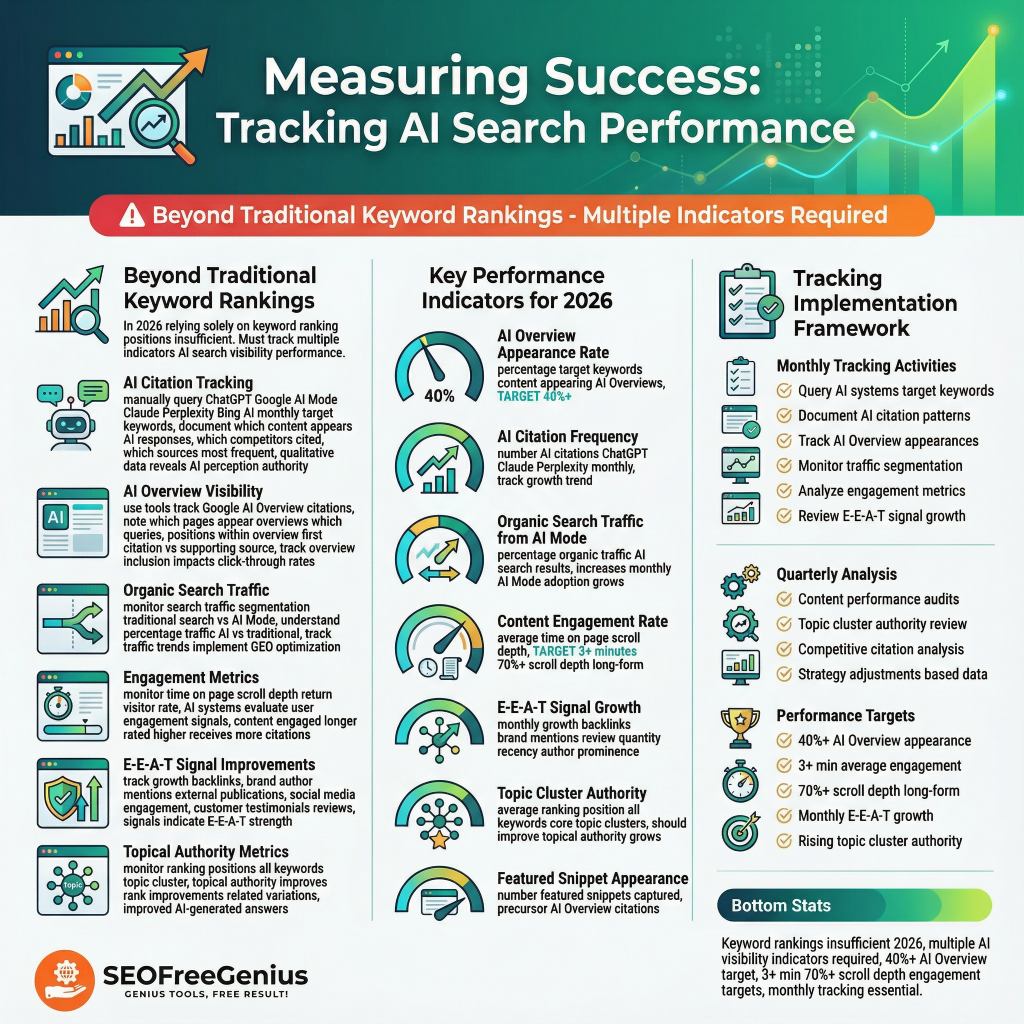
Beyond Traditional Keyword Rankings
In 2026, relying solely on keyword ranking positions as your success metric is insufficient. You must track multiple indicators of AI search visibility and performance.
AI Citation Tracking: Manually query ChatGPT, Google AI Mode, Claude, Perplexity, and Bing AI monthly with your target keywords. Document which content appears in AI responses, which competitors are cited instead, and which sources appear most frequently. This qualitative data reveals how AI systems perceive your content’s authority.
AI Overview Visibility: Use tools that track Google AI Overview citations. Note which pages appear in overviews, for which queries, and in what positions within the overview (first citation vs. supporting source). Track how overview inclusion impacts your click-through rates compared to traditional ranking positions.
Organic Search Traffic: Monitor search traffic segmentation between traditional search results and AI Mode. As Google expands AI Mode, understand what percentage of your traffic comes from AI vs. traditional results. Track traffic trends as you implement GEO optimization.
Engagement Metrics: Monitor time on page, scroll depth, and return visitor rate on important content. AI systems evaluate user engagement signals. Content that keeps users engaged longer is rated higher by AI systems and receives more citations.
E-E-A-T Signal Improvements: Track the growth of backlinks to your content, mentions of your brand and authors in external publications, social media engagement with your content, and customer testimonials and reviews. These signals collectively indicate E-E-A-T strength.
Topical Authority Metrics: Monitor your ranking positions across all keywords within a topic cluster. As your topical authority improves, you should see rank improvements across related keyword variations and improved performance in AI-generated answers about that topic.
Key Performance Indicators for 2026
- AI Overview Appearance Rate: Percentage of target keywords with your content appearing in AI Overviews (target: 40%+)
- AI Citation Frequency: Number of AI citations from ChatGPT, Claude, Perplexity monthly (track growth trend)
- Organic Search Traffic from AI Mode: Percentage of organic traffic coming from AI search results (increases monthly as AI Mode adoption grows)
- Content Engagement Rate: Average time on page and scroll depth (target: 3+ minutes, 70%+ scroll depth for long-form)
- E-E-A-T Signal Growth: Monthly growth in backlinks, brand mentions, review quantity and recency, and author prominence
- Topic Cluster Authority: Average ranking position for all keywords within your core topic clusters (should improve as topical authority grows)
- Featured Snippet Appearance: Number of featured snippets captured (precursor to AI Overview citations)
Conclusion: Adapt Your Strategy for the AI-First Search Era
The search landscape in 2026 bears little resemblance to 2020—or even 2024. AI-driven ranking signals, generative search results, and semantic understanding have fundamentally replaced keyword-matching algorithms. Brands that adapt to this new reality will see dramatic ranking improvements and increased organic traffic. Those that ignore these trends will experience declining visibility and traffic erosion.
The good news? The strategies outlined in this guide are proven, implementable, and within reach for organizations of every size. Start with your content audit, prioritize AI optimization for your top-performing pages, and progressively build topical authority and E-E-A-T signals across your website.
The path forward is clear: Focus on genuine expertise, comprehensive content, clear E-E-A-T signals, and AI-friendly content structure. Optimize for semantic understanding rather than keyword matching. Build topical authority through interconnected content clusters. Track AI citation and search performance as carefully as traditional keyword rankings.
The future of SEO isn’t about gaming algorithms—it’s about creating genuine value, demonstrating authentic expertise, and structuring that content in ways AI systems can easily understand, evaluate, and recommend to their users. Your 2026 search rankings will be determined by the decisions you make today. Start implementing these strategies immediately, and you’ll be positioned ahead of the 90% of competitors still optimizing for 2024-era SEO.
Quick Reference: 2026 SEO Optimization Checklist
- Content audit for AI optimization readiness and depth
- Author credentials and expertise signals added to all key content
- Generative Engine Optimization (GEO) best practices implemented
- Google AI Mode and AI Overviews optimization completed
- Answer-first content structure implemented
- Comprehensive Schema.org markup implemented (Article, FAQ, HowTo, Organization, Person)
- Topical authority clusters created and internal linking optimized
- Core Web Vitals optimized and page speed improved
- AI-friendly content formats (tables, lists, summaries, structured answers) implemented
- Content update schedule established with quarterly refreshes
- Citations from authoritative sources built
- AI search performance monitoring system implemented
- Video content strategy developed and YouTube optimization completed
- Local SEO hyper-localization strategy implemented
- Thin, low-value content removed or substantially improved
- E-E-A-T signals strengthened across author profiles and company information
- Topic clusters created with pillar pages and supporting content
- Structured data audit completed and gaps filled
- Content freshness signals (publication dates, update logs) added
- Featured snippet optimization completed
Final Note: SEO in 2026 requires constant evolution and learning. The strategies in this guide represent the current best practices, but search algorithms continue to evolve. Stay informed by following industry leaders like Backlinko’s research on Google ranking factors, Search Engine Journal’s algorithm updates, and industry reports on AI search trends. Your commitment to understanding and implementing these strategies will determine your success in the AI-first search era.
Samir H. M. — SEO Expert
5+ years building SEO tools. SEOFreeGenius creator—50+ sites to #1.
All Articles →
Samir H. M. is the creator of [seofreegenius.com], offering 66+ free SEO tools from Riyadh. He’s hands-on tested and built features like plagiarism checkers and backlink tools, plus 36 guides to help sites rank better. Practical, no-BS advice for real users.