
Introduction
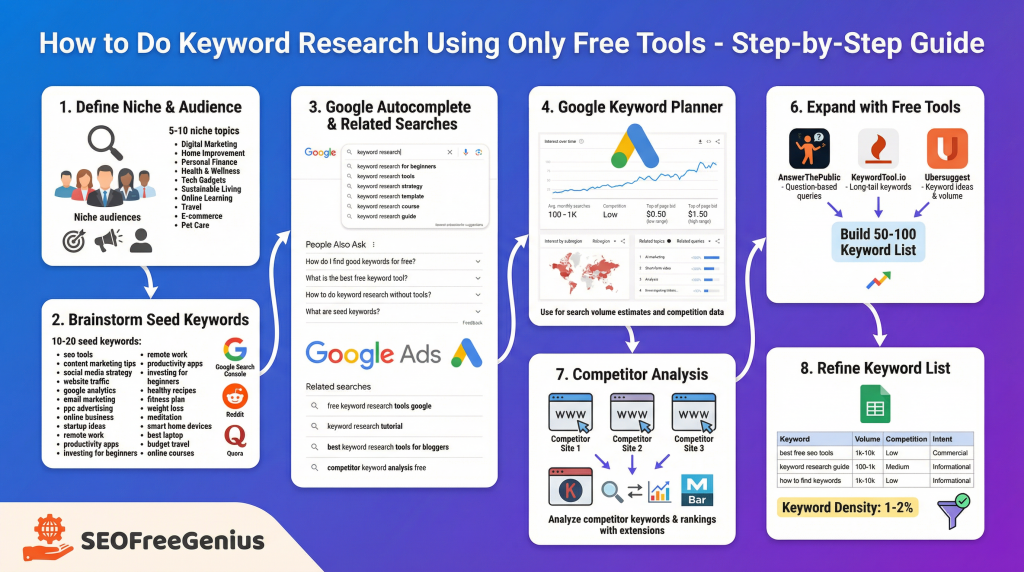
In the ever-evolving world of SEO in 2026, keyword research remains the foundation of any successful digital marketing strategy. It helps you understand what your audience is searching for, uncover content opportunities, and optimize your website to rank higher on search engines like Google. The best part? You don’t need expensive paid tools to do effective keyword research. With free resources readily available, anyone can master this process. This step-by-step guide will walk you through how to do keyword research using only free tools. We’ll cover everything from brainstorming ideas to refining your keyword list, ensuring clarity and accuracy every step of the way. By incorporating these methods, you can boost your site’s visibility and drive organic traffic without spending a dime. For additional free SEO resources, check out SEOFreeGenius, where you can access tools like the Keyword Density Checker to fine-tune your content.
Ultimate 2026 Keyword Research Guide: 8 Steps – 100% Free Tools Only
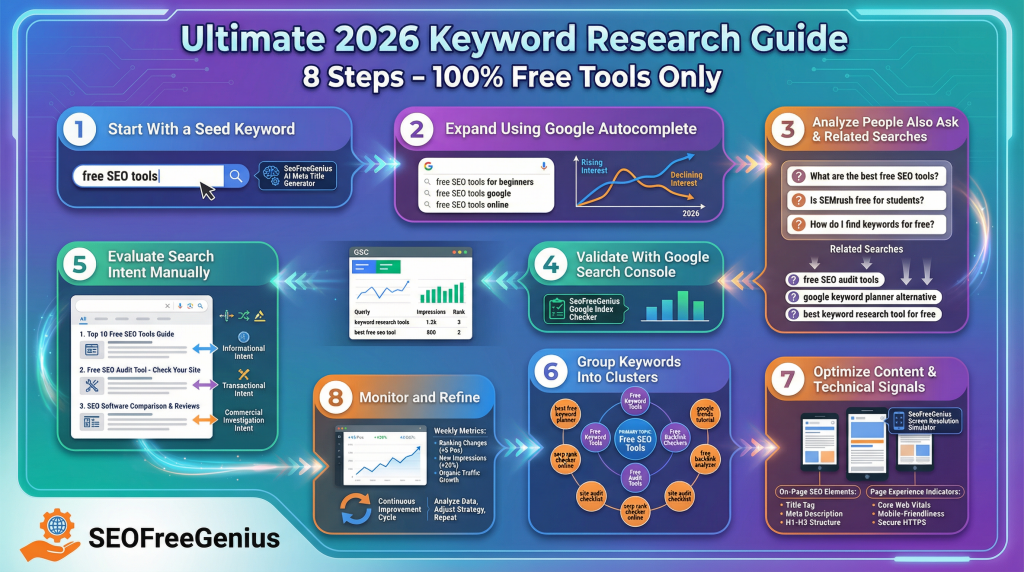
In this complete guide, you’ll discover the exact 8-step process thousands of bloggers, marketers, and site owners are using in 2026 to find profitable keywords — completely for free.
Step 1: Define Your Niche and Target Audience
Before diving into tools, start with the basics. Keyword research using free tools begins with a clear understanding of your niche, business goals, and audience. Ask yourself:
- What problems does my audience face?
- What terms would they use to search for solutions?
- Who are my competitors?
Create a simple list of 5-10 broad topics related to your site. For example, if you’re in the fitness niche, topics might include “home workouts,” “healthy eating,” or “weight loss tips.”
This foundational step ensures your research is targeted. To learn more about optimizing for user intent, read our blog post on Leveraging Google AI Trends for Better Rankings in 2026 at SEOFreeGenius.
Step 2: Brainstorm Seed Keywords Manually
Seed keywords are the core terms that define your niche. Use free brainstorming methods to generate them:
- Think like your audience: Write down obvious search terms.
- Check your website analytics: If you have Google Search Console set up (it’s free), look at existing queries driving traffic.
- Explore forums: Sites like SEO Chat forums or Quora reveal real user questions.
Aim for 10-20 seed keywords. This manual approach is tool-free and sets the stage for deeper research. Need more inspiration? Discover semantically related topics instantly with our [AI Keyword Cluster Ideas] tool. For beginners, our Free SEO Tools Checklist 2026 provides more tips on getting started.
Step 3: Use Google Autocomplete and Related Searches
Google itself is one of the best free tools for keyword research. Start typing your seed keywords into the Google search bar and note the autocomplete suggestions—these are popular searches.
For example, typing “keyword research” might suggest “keyword research tools free” or “keyword research for SEO.”
Scroll to the bottom of the search results for “Related searches,” which offers long-tail keyword ideas like “how to do keyword research step by step.”
This method uncovers low-competition keywords quickly. Combine it with Google’s “People Also Ask” section for question-based keywords, which are great for voice search optimization in 2026.
Automate This: Tired of manual typing? Generate hundreds of autocomplete suggestions in one click using our free [Keywords Suggestion Tool].
Step 4: Leverage Ubersuggest for Data Insights
Ubersuggest is a powerful free tool (no Ads account needed) for keyword research. Here’s how to use it:
- Sign in at https://app.neilpatel.com/en/ubersuggest/ and select “Keyword Research.”
- Enter your seed keywords.
- Filter by location, language; review metrics like average monthly searches, SEO difficulty, and paid difficulty.
Focus on keywords with decent search volume (100-1000 monthly searches) and low SEO difficulty (<30) for easier ranking. Export data to spreadsheet for further analysis. This delivers accurate, data-driven insights straight from search trends.
Step 5: Analyze Trends with Google Trends
To ensure your keywords have staying power, use Google Trends. This free tool shows search interest over time:
- Enter a keyword and compare it with similar terms.
- Check regional interest and related queries.
- Look for rising trends, especially with AI-influenced searches in 2026.
For instance, compare “AI SEO tools” vs. “free keyword research” to spot seasonal or emerging opportunities. Google Trends helps you avoid outdated keywords and prioritize those with growing popularity. For more on future-proofing your strategy, see our article on 5 Crucial Changes in SEO for 2026.
Step 6: Expand Ideas with AnswerThePublic and Similar Free Tools
AnswerThePublic offers a free limited version that visualizes search queries as questions, prepositions, and comparisons. Input a seed keyword, and it generates hundreds of ideas based on real searches.
Other free alternatives include:
- KeywordTool.io (free for basic results, pulls from Google Autocomplete).
- Ubersuggest (free for a few daily searches, shows volume and difficulty).
These tools help discover long-tail keywords, which are easier to rank for and convert better. Limit your list to 50-100 keywords at this stage.
Step 7: Conduct Competitor Analysis for Free
Spy on competitors without paid software:
- Search your seed keywords on Google and note top-ranking sites.
- Use free browser extensions like Keywords Everywhere (limited free credits) to see related keywords and metrics directly in search results.
- Manually review competitor content for keywords in titles, headings, and meta descriptions.
Rank Check: Want to see exactly where your competitors stand? Track their rankings instantly with our [Keyword Position Checker]
Tools like MozBar (free Chrome extension) provide page authority insights. This step reveals gaps you can fill with better content.
Once you’ve identified keywords, optimize your pages using our Backlink Checker to build supporting links.
Step 8: Refine and Validate Your Keyword List
Compile your findings into a spreadsheet with columns for keyword, search volume, competition, and intent (informational, navigational, commercial, or transactional).
Prioritize based on:
- Relevance to your content.
- Balance of volume and difficulty.
- User intent alignment.
Test keywords by creating sample content and checking density with free tools like the Keyword Density Checker at SEOFreeGenius. Aim for 1-2% density to avoid stuffing. Finally, integrate keywords into your site. For tips on implementation, explore our guide on Word Count Optimization.
Conclusion
Mastering keyword research using only free tools in 2026 is straightforward and effective when following this step-by-step guide. From Google’s built-in features to specialized free platforms, you have everything needed to uncover high-potential keywords and improve your SEO rankings. Remember, consistency is key—regularly update your research to adapt to algorithm changes. For more advanced strategies, visit SEOFreeGenius and explore our full suite of free tools, including the Domain Authority Checker and Mozrank Checker. Start implementing today and watch your traffic grow!