Introduction
The allure of free SEO tools is undeniable. In 2026, millions of webmasters, content creators, and digital marketers search for solutions to optimize their websites without breaking the bank. But here’s the billion-dollar question: How do you build a thriving, sustainable business around free tools without driving users away with aggressive monetization tactics?
The truth is, many free SEO tool platforms struggle with profitability. They offer genuine value—yet their business models remain uncertain. The problem isn’t the tools themselves; it’s the monetization strategy. This comprehensive guide reveals how to transform a free SEO tools website like SEOFreeGenius into a profitable, sustainable business while maintaining user trust and delivering exceptional value. You’ll learn proven revenue strategies that don’t compromise the user experience.
Why Free SEO Tools Matter More Than Ever
The demand for free SEO tools has exploded. According to industry data, free tools like Ubersuggest (free keyword volume tool), Plausible Analytics, and Google Search Console drive billions of searches annually. Users desperately need affordable solutions to:
- Conduct keyword research without expensive enterprise software
- Audit their websites for technical issues
- Analyze competitor backlinks
- Check site speed and Core Web Vitals
- Generate XML sitemaps and robots.txt files
- Optimize meta tags and content
The problem? Most users expect these services to be completely free—forever. This creates a genuine tension: How do you monetize without betraying user trust?
The answer isn’t through aggressive paywalls or intrusive advertisements. Instead, it requires a strategic approach that transforms free tools into lead magnets for premium services.
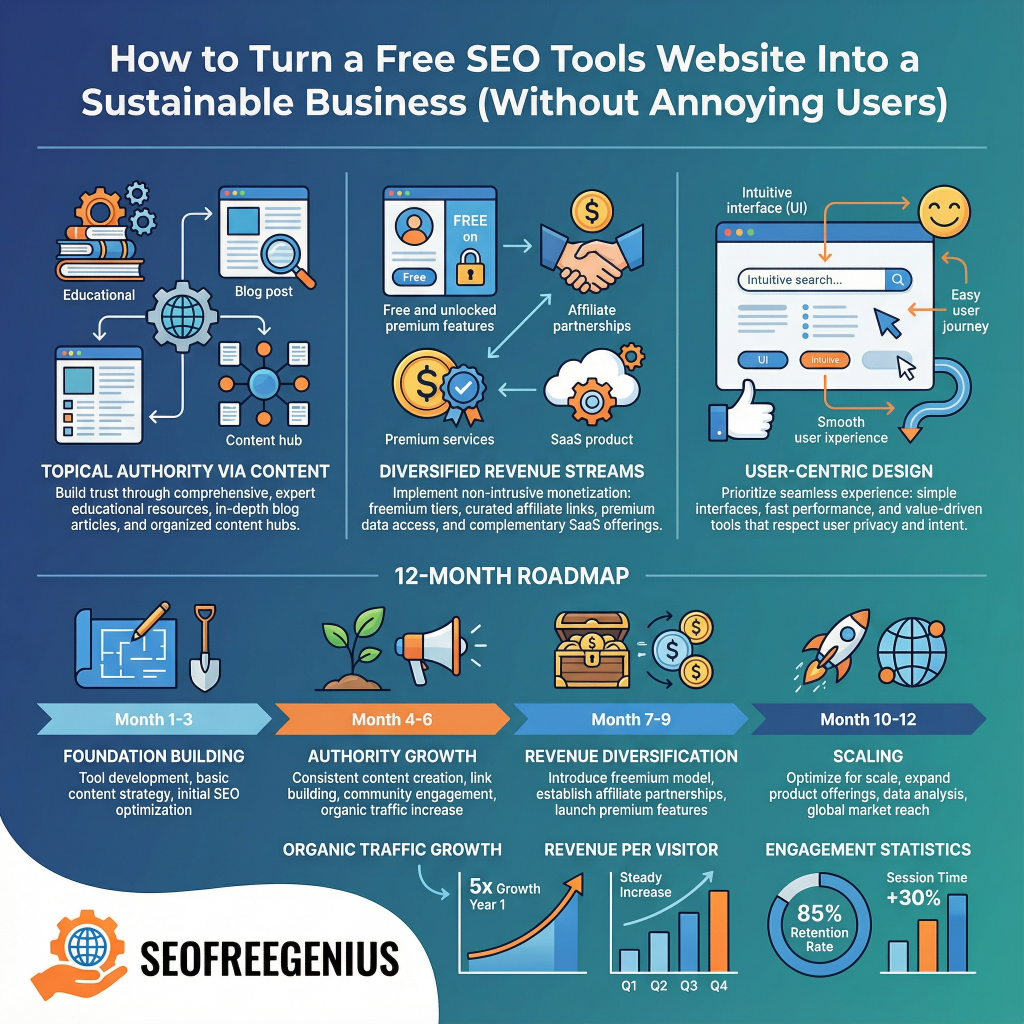
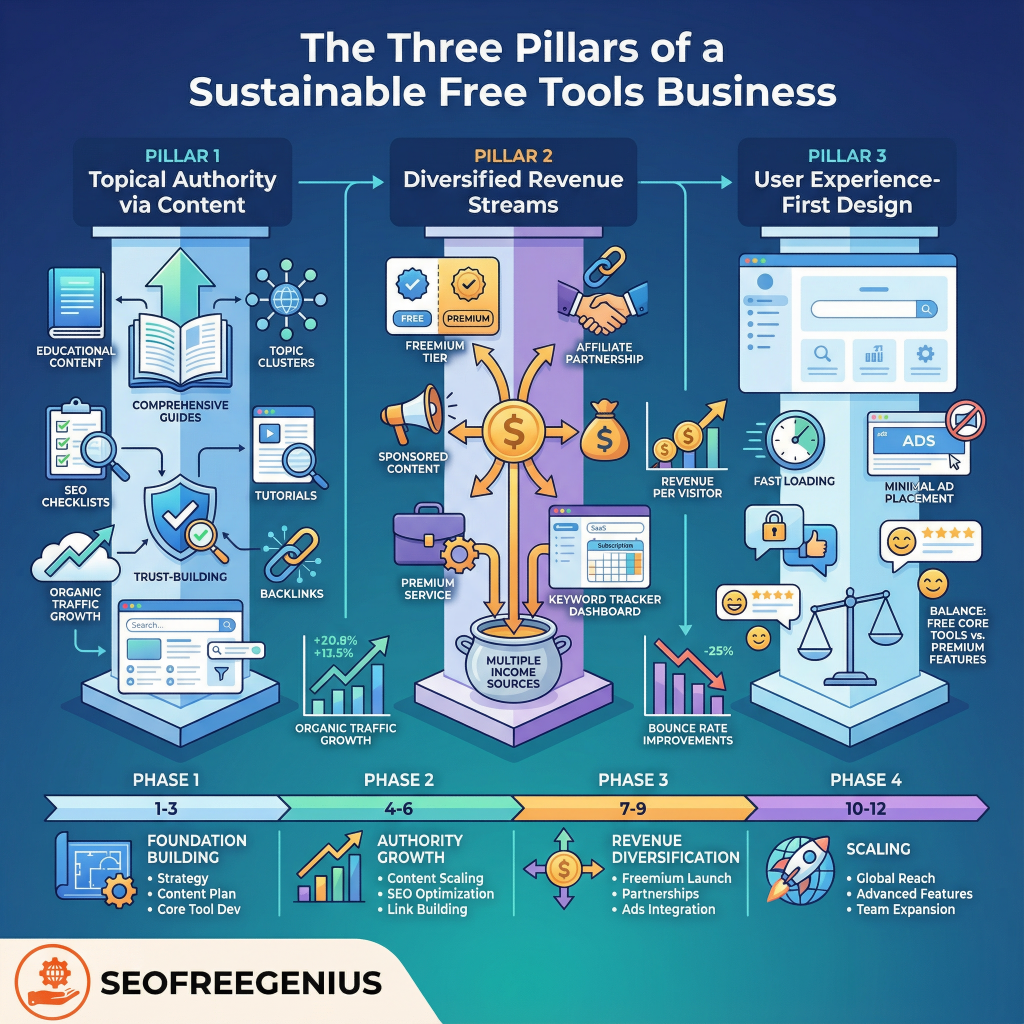
The Three Pillars of a Sustainable Free Tools Business
Pillar 1: Establish Topical Authority Through Content
The first step to sustainable growth is creating an authoritative content hub around your tools. Rather than simply offering tools, you become an educator.
How SEOFreeGenius has executed this strategy:
The SEOFreeGenius blog doesn’t just promote tools—it provides comprehensive guides that address real user problems. For example, their on-page SEO checklist for small websites directly helps users optimize their sites in a single afternoon using free tools.
Why this works:
- Builds trust and authority with your audience
- Drives organic traffic through long-tail keywords
- Creates natural opportunities to feature your tools within educational content
- Establishes you as an expert, not just a tool provider
- Generates backlinks and social shares from higher-authority websites
Implementation strategy:
- Create beginner guides that teach fundamental concepts (e.g., “SEO for Complete Beginners,” “Technical SEO on Shared Hosting”)
- Develop intermediate tutorials that showcase specific tools in action
- Write in-depth guides solving specific problems (e.g., “How to Maximize Site Speed on Shared Hosting”)
- Link internally to relevant tools throughout content
- Structure content around topic clusters to improve topical authority
For instance, SEOFreeGenius’s article on maximizing site speed on shared hosting naturally recommends the Meta Tags Analyzer and Robots.txt Generator tools when relevant—not as aggressive sales pitches, but as helpful resources.
Expected outcomes:
- Rankings for 50-100+ long-tail keywords within 6-12 months
- Organic traffic growth of 20-40% month-over-month
- 2-4 position improvements in search rankings
- Higher engagement metrics (lower bounce rate, longer session duration)
Pillar 2: Create Multiple Revenue Streams (Beyond the Obvious Ads)
The fatal mistake most free tool platforms make is relying on banner ads as the primary revenue model. This doesn’t work. Users hate ads, and aggressive ad placements destroy the user experience—the very thing that gave you an audience in the first place.
Instead, diversify your revenue through multiple, non-intrusive channels:
A. Premium Tool Tiers (Freemium Model)
Offer a free version of your core tools with clear limitations, then provide upgraded versions for power users:
Example structure:
- Free tier: 5 keyword searches per month, basic domain analysis
- Premium tier: Unlimited searches, advanced filtering, competitor tracking, API access
This works because casual users never upgrade, but professionals and agencies gladly pay $9-29/month for features that save them hours.
Value Check: How much is that traffic worth? Estimate the potential ad revenue of your target keywords with our free [Keyword CPC Calculator].
Recommend complementary paid tools and services within your content and tools. For example:
- Recommend hosting providers (SiteGround, Kinsta, Bluehost) with affiliate links
- Link to premium SEO tools (Semrush, Ahrefs, SEMrush) when discussing advanced features
- Suggest WordPress plugins like Yoast SEO or Rank Math
- Recommend learning platforms for advanced SEO courses
Important: Only recommend products you’ve actually tested. Authentic recommendations maintain user trust.
C. Sponsored Content and Partnerships
As your authority grows, SEO tool vendors and marketing platforms will pay to reach your audience:
- Sponsored tool reviews ($500-2,000 per review)
- Native advertising within guides ($1,000-5,000 per month)
- Podcast sponsorships or webinar partnerships
- Email newsletter sponsorships
Requirement: Clearly label sponsored content and maintain editorial independence. Users can spot—and resent—dishonest promotion.
Once you’ve established authority through free tools and content:
- SEO consulting: Charge $100-300/hour for one-on-one guidance
- Technical audits: $500-2,000 per comprehensive site audit
- Link building services: $1,000-5,000 per project
- Content strategy: $50-150 per article, or retainer packages
Your free tools become proof-of-concept. Users who find value in them become natural customers for your paid services.
Transform popular free tools into subscription software:
- Keyword tracking SaaS: Monitor rankings for specific keywords, get alerts when positions change ($29-99/month)
- Site audit SaaS: Automated weekly site health checks with detailed reports ($49-199/month)
- Backlink monitoring: Track new backlinks, spot opportunities, monitor competitor link building ($39-149/month)
Pillar 3: Design for User Experience, Not Revenue Extraction
This is the hardest principle, but also the most important: Design your monetization around user value, not maximum ad impression or conversion rates.
The User Experience Commandments:
1. Keep Core Tools 100% Free
Never put a paywall on your most popular tools. The keyword analyzer, backlink checker, and XML sitemap generator must remain completely free. This is your traffic magnet.
2. No Intrusive Ads Above the Fold
Avoid banner ads, pop-ups, and auto-playing videos at the top of tool pages. These destroy the experience and encourage users to find competitors.
3. Ad Placement Strategy
- Place ads in the sidebar (right side, below the fold)
- Use contextual ads that relate to SEO tools (not random display ads)
- Consider limiting ads to 1-2 per page maximum
- Never auto-play videos or sound
4. Fast Load Times
Since you’re offering free tools, users expect them to load instantly. Slow pages drive away users and hurt your SEO rankings. Keep pages under 2 seconds to load.
5. No Aggressive Pop-Ups
Avoid:
- Pop-ups that appear immediately on page load
- Auto-expanding ads that cover content
- Email signup modals that appear before tool use
- “Create account to save results” barriers
Instead:
- Offer non-intrusive email signup suggestions after tool use
- Let users save results through simple, optional login
- Show CTAs only after providing significant value
6. Transparent Limitations
If a free tool has limits (searches, results, exports), clearly communicate them upfront. Users understand free tiers—they resent hidden restrictions. Example from SEOFreeGenius: The word counter tool is completely free with no limits, because the barrier to entry is so low that monetization through limitations would feel petty.
Secure Data: Need to hash passwords or sensitive data for your users? Use our fast, client-side [Online Md5 Generator] without any limits.
The Complete Monetization Framework
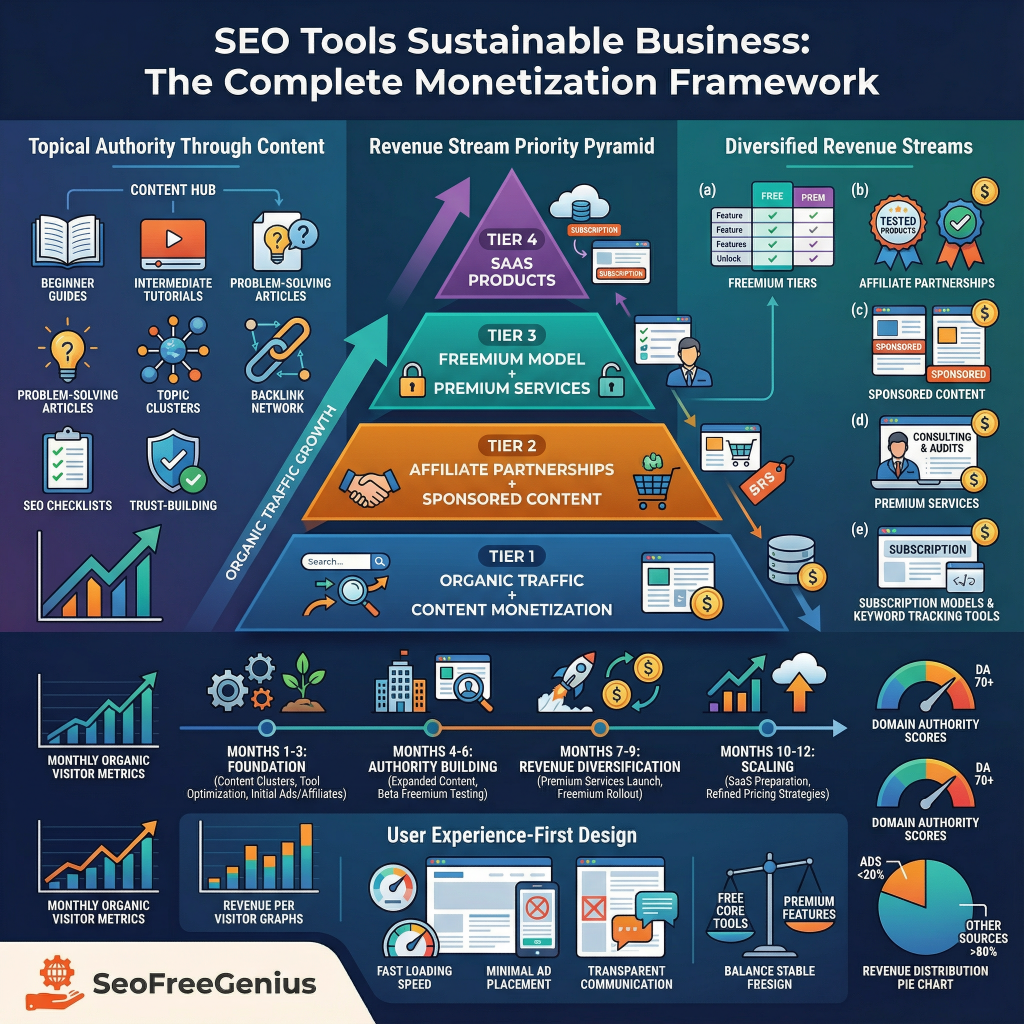
Here’s how to structure your business model for maximum revenue without annoying users:
Revenue Stream Priority Pyramid:
Tier 1 (Core Revenue): Organic search traffic + content monetization
- Expected revenue: 40-50% of total
- Build through SEO-optimized content driving qualified traffic
Tier 2 (Complementary): Affiliate partnerships + sponsored content
- Expected revenue: 20-30% of total
- Low friction, high-relevance recommendations
Tier 3 (Premium): Freemium tools + premium services
- Expected revenue: 20-30% of total
- Available for users who want more power and features
Tier 4 (Scalable): SaaS products
- Expected revenue: 10-20% of total (growing over time)
- Long-term sustainable revenue base
Implementation: A 12-Month Roadmap to Sustainability
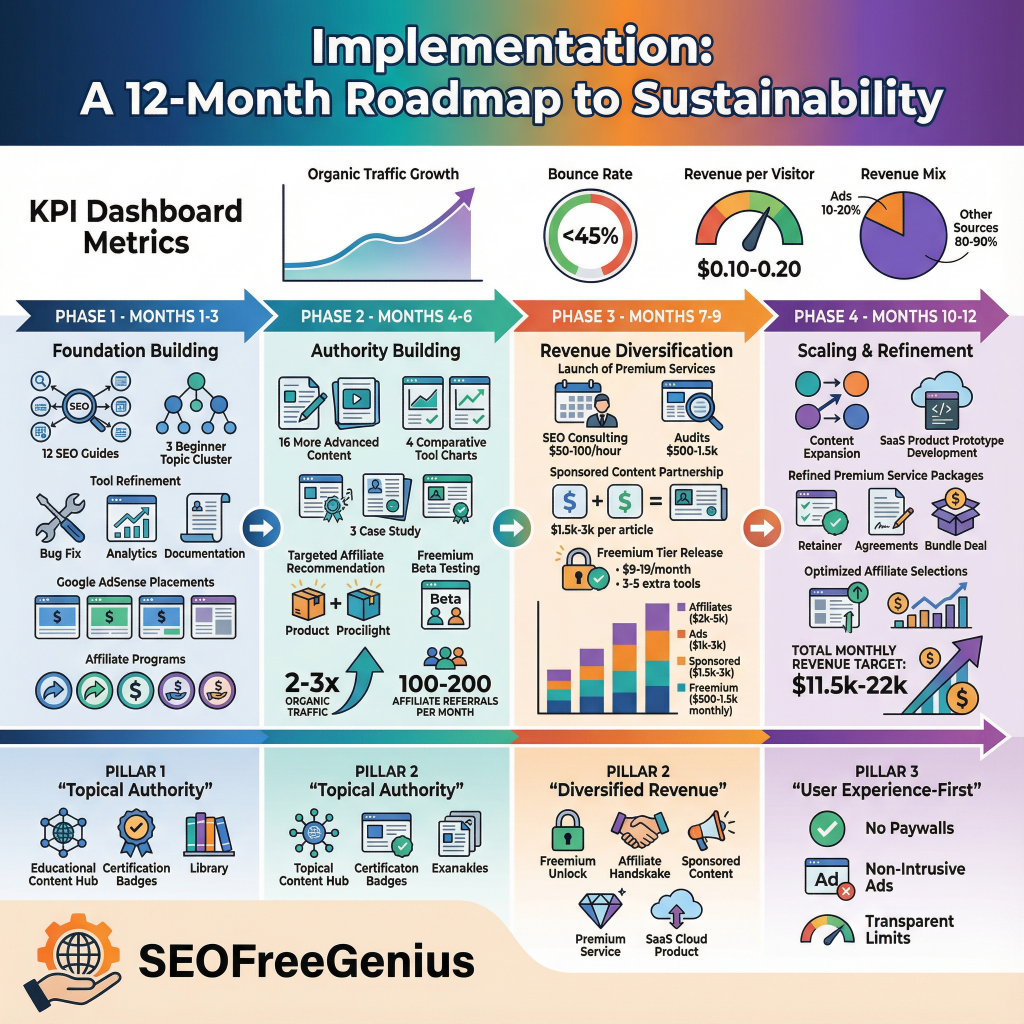
Months 1-3: Foundation Building
Content Strategy
- Publish 8-12 comprehensive guides on core SEO topics
- Build beginner cluster (content linking strategy around foundational topics)
- Optimize for keywords with 500-5,000 monthly searches
Tool Enhancement
- Ensure core tools work flawlessly (no bugs, fast load times)
- Implement basic analytics to understand user behavior
- Create simple documentation for each tool
Initial Monetization
- Set up Google AdSense (low-impact ads)
- Create affiliate accounts with 3-5 relevant partner programs
- Plan premium feature roadmap
Example: SEOFreeGenius publishes their Beginner SEO Cluster covering foundational concepts, driving new user discovery.
Months 4-6: Authority Building
Content Expansion
- Publish 12-16 additional guides
- Create tool comparison content (“Why Use [Your Tool] vs Paid Competitors”)
- Develop case studies showing tool effectiveness
Affiliate Revenue Launch
- Actively place affiliate recommendations within content
- Select 2-3 primary affiliate programs with high conversion rates
- Track performance and optimize recommendations
Premium Tool Features
- Beta test freemium features with select users
- Gather feedback and iterate
- Plan official premium tier launch
Expected metrics:
- 2-3x increase in organic traffic
- 100-200 qualified affiliate referrals per month
- Growing engaged user base on email list
Months 7-9: Revenue Diversification
Premium Services Launch
- Offer SEO consulting or audits
- Position as natural next step for power users
- Price conservatively to build initial client base ($50-100/hour consulting, $500-1,500 for audits)
Sponsored Content Strategy
- Launch content partnerships with 1-2 relevant brands
- Create sponsored guides with clear labeling
- Establish rate card ($1,500-3,000 per sponsored article)
Freemium Launch
- Release premium tool tier with 3-5 features
- Price at $9-19/month
- Target power users and professional agencies
Expected revenue:
- Affiliate: $2,000-5,000/month
- Ad revenue: $1,000-3,000/month
- Sponsored content: $1,500-3,000/month
- Freemium: $500-1,500/month
- Total: $5,000-12,500/month
Months 10-12: Scaling and Refinement
Audience Expansion
- Expand content into new adjacent topics
- Build community through email newsletter
- Develop content calendar for sustained publishing
SaaS Preparation
- Develop at least one SaaS product prototype
- Test with beta users
- Plan launch for Month 13-15
Premium Services Refinement
- Refine service offerings based on demand
- Develop package deals and retainers
- Build case studies from successful projects
Affiliate Optimization
- Double-down on top-performing affiliates
- Negotiate higher commission rates
- Create exclusive partnerships
Expected revenue (Month 12):
- Organic/ads: $3,000-5,000/month
- Affiliate: $3,000-6,000/month
- Sponsored content: $2,000-4,000/month
- Freemium: $1,500-3,000/month
- Consulting/services: $2,000-4,000/month
- Total: $11,500-22,000/month
Case Study: How Strategic Content Drives Tool Usage
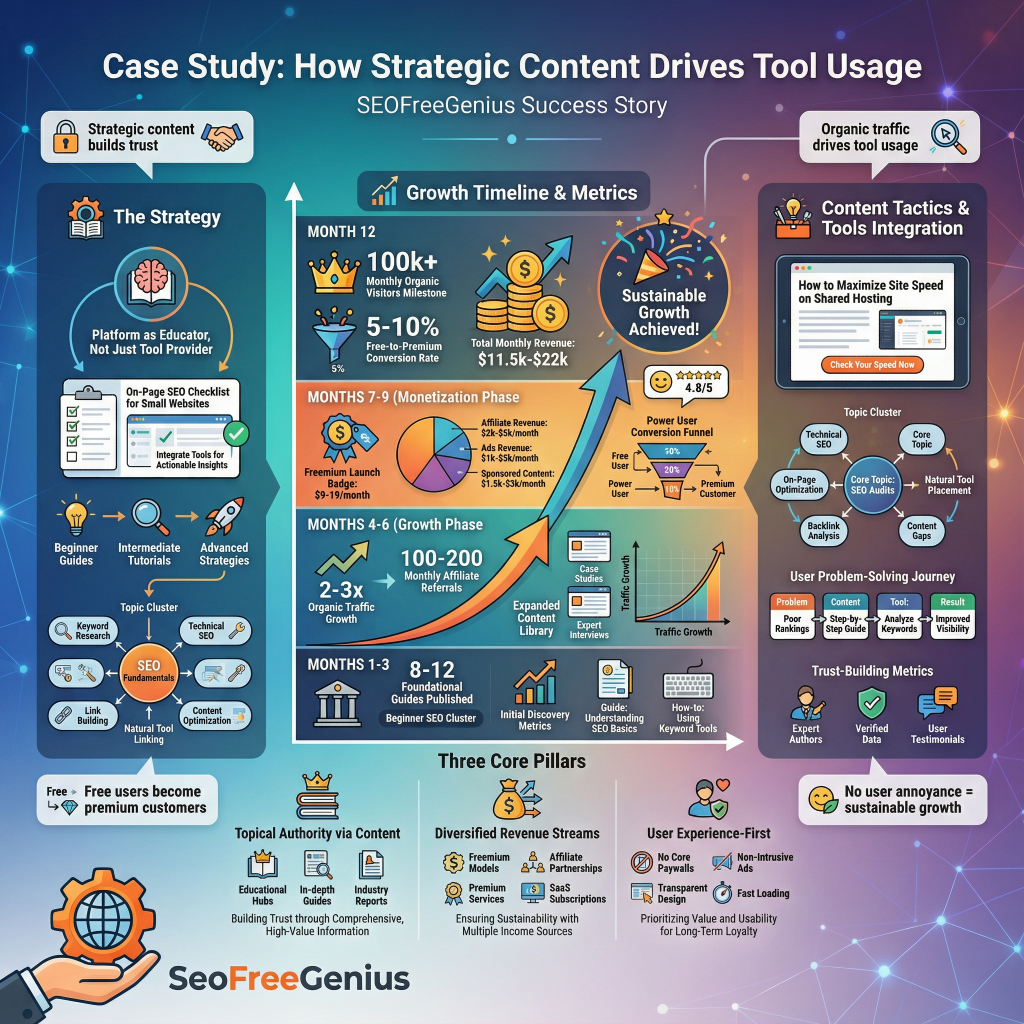
The SEOFreeGenius blog provides an excellent case study in how to monetize without annoying users.
The Strategy:
- Article: “On-page SEO Checklist for Small Websites”
- Within the article, they naturally mention the Meta Tags Analyzer for verifying title tags
- And the Keyword Density Checker for analyzing content optimization
- Plus the Broken Links Finder for auditing links
Why it works:
Users aren’t interrupted by ads. Instead, they discover tools that directly solve the problem the article addresses. It’s natural, helpful, and non-intrusive.
Replicable formula:
- Write comprehensive, helpful article
- Identify 2-3 tools that help solve the article’s topic
- Link to tools naturally within the guide (not in separate “recommended tools” section)
- Let users discover and try the tools at their own pace
- Provide premium features for users who want more power
Common Mistakes to Avoid
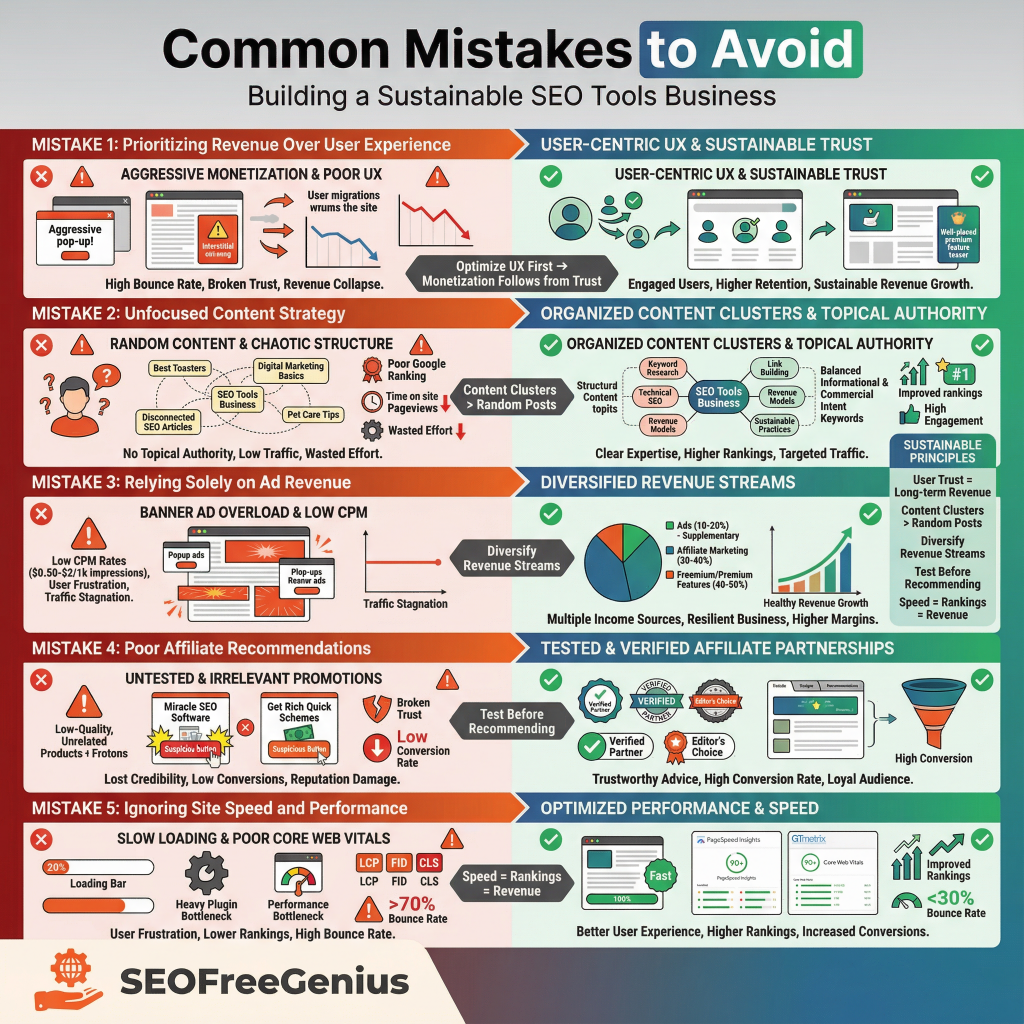
Mistake 1: Prioritizing Revenue Over User Experience
The trap: Implementing aggressive ads, pop-ups, or paywalls too early.
The cost: Users migrate to competitors. Traffic drops. Revenue eventually follows.
The solution: Optimize for user experience first. Monetization follows naturally from engaged, trusting users.
Mistake 2: Unfocused Content Strategy
The trap: Publishing random articles about SEO without thematic connection or purpose.
The cost: Poor Google rankings. Low user engagement. Wasted effort.
The solution: Build content clusters around core topics. Create internal linking strategy. Target keywords with commercial intent mixed with informational content.
Mistake 3: Relying Solely on Ad Revenue
The trap: Banner ads generate $0.50-2 per 1,000 impressions. At scale, this barely covers server costs.
The cost: Forced to add more ads, which destroys UX, which kills traffic growth.
The solution: Use ads as supplementary revenue (10-20% of total). Focus on affiliate partnerships, freemium features, and premium services (80-90% of total).
Mistake 4: Poor Affiliate Recommendations
The trap: Recommending tools you haven’t tested, or tools that don’t serve user needs.
The cost: Users notice inauthentic recommendations. Trust erodes. Conversion rates plummet.
The solution: Only recommend products you genuinely use and believe in. Make recommendations contextual and helpful, not forced.
Mistake 5: Ignoring Site Speed and Performance
The trap: Adding too many ads, plugins, or features that slow down pages.
The cost: Poor Core Web Vitals metrics. Lower Google rankings. Higher bounce rates.
The solution: Keep tool pages lean. Optimize for speed. Monitor with WebPageTest and GTmetrix.
The Competitive Advantage: Why Free Tools Beat Paid
In 2026, the SEO tool landscape is crowded. Premium tools like Semrush and Ahrefs dominate the market. So how can a free tool platform compete?
The answer: You’re not trying to replace premium tools. You’re providing an alternative path to SEO success for:
- Freelancers and agencies on tight budgets
- Small business owners just starting with SEO
- Bloggers testing SEO strategy before investing in paid tools
- Teams that only need occasional tool access (not daily use)
Your competitive moat is accessibility, not features.
Research shows that using free tools like SEOBoost, consistently can generate measurable SEO results. Users can rank on page one, drive traffic, and grow their business using free tools combined with strong content strategy.
Your job is to:
- Prove this is possible through case studies and content
- Make your free tools the best-in-class free options
- Help users graduate to premium services as they scale
Technical Implementation: The Non-Annoying Monetization Stack
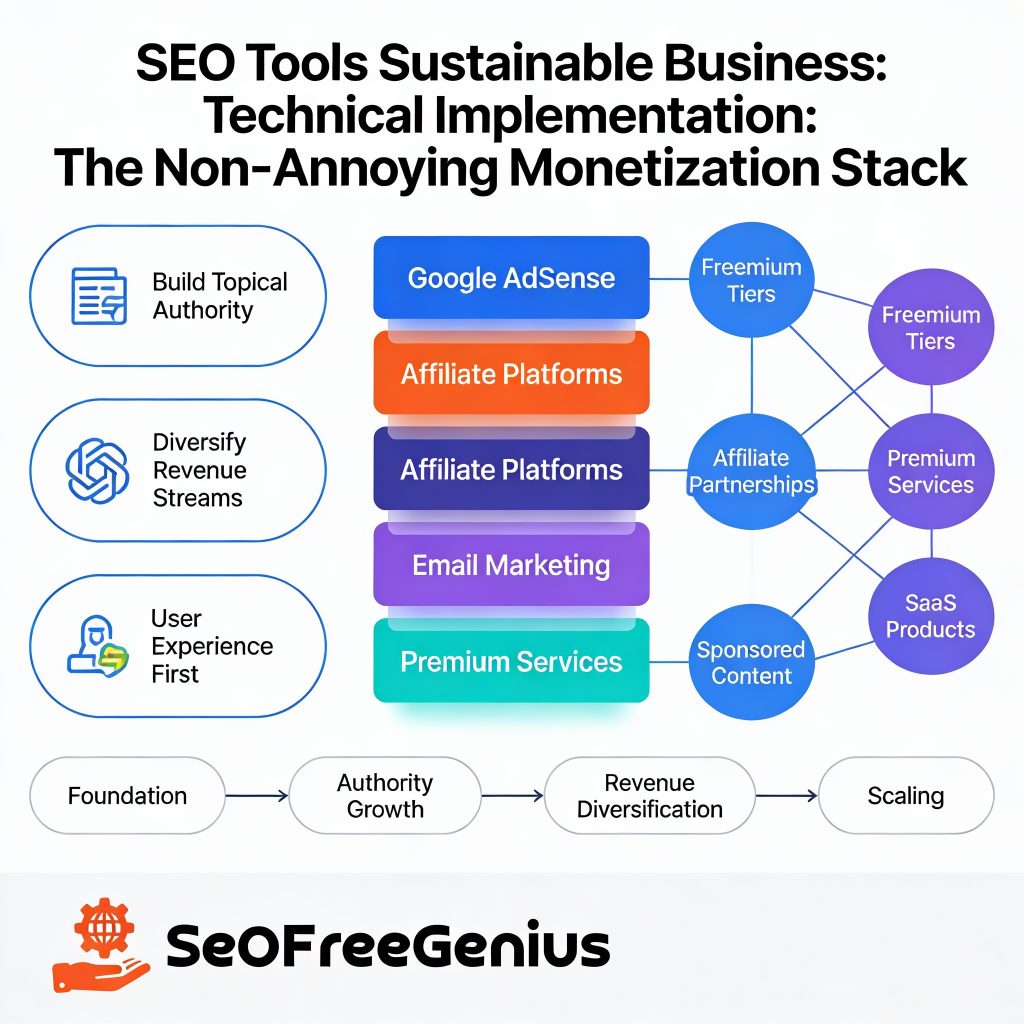
Here’s the technical setup that maintains user experience while generating revenue:
- Provider: Google AdSense (contextual, relevant to SEO)
- Placement: Sidebar only, below the fold
- Limit: Maximum 2 ads per page
- Exclusions: Never above tool input areas or blocking results
- Expected revenue: $1,000-3,000/month (for 50,000+ monthly visitors)
- Platform: Impact or Refersion (professional affiliate networks)
- Disclosure: Clear “This is an affiliate link” note before every affiliate recommendation
- Stay Legal: Ensure your site is fully compliant with affiliate disclosure laws by creating a custom policy with our [Privacy Policy Generator].
- Selection: Maximum 5-7 partner programs with strong payouts
- Expected revenue: $2,000-6,000/month (for 100,000+ monthly visitors)
Email List Building (Non-Intrusive)
- Strategy: Optional email signup after tool use (not mandatory)
- Frequency: Send 1 email per week with free tips, tool usage guides, and occasional promotions
- Monetization: Affiliate recommendations, sponsored content, premium service offers
- Expected revenue: $500-2,000/month (1% of list engaged in purchases)
- Platform: Stripe for payments, Auth0 for user management
- Pricing: $9-19/month for power users
- Features: Unlimited searches, saved results, API access, priority support
- Expected revenue: $1,000-3,000/month (5-10% of free users upgrade)
Measuring Success: KPIs That Matter
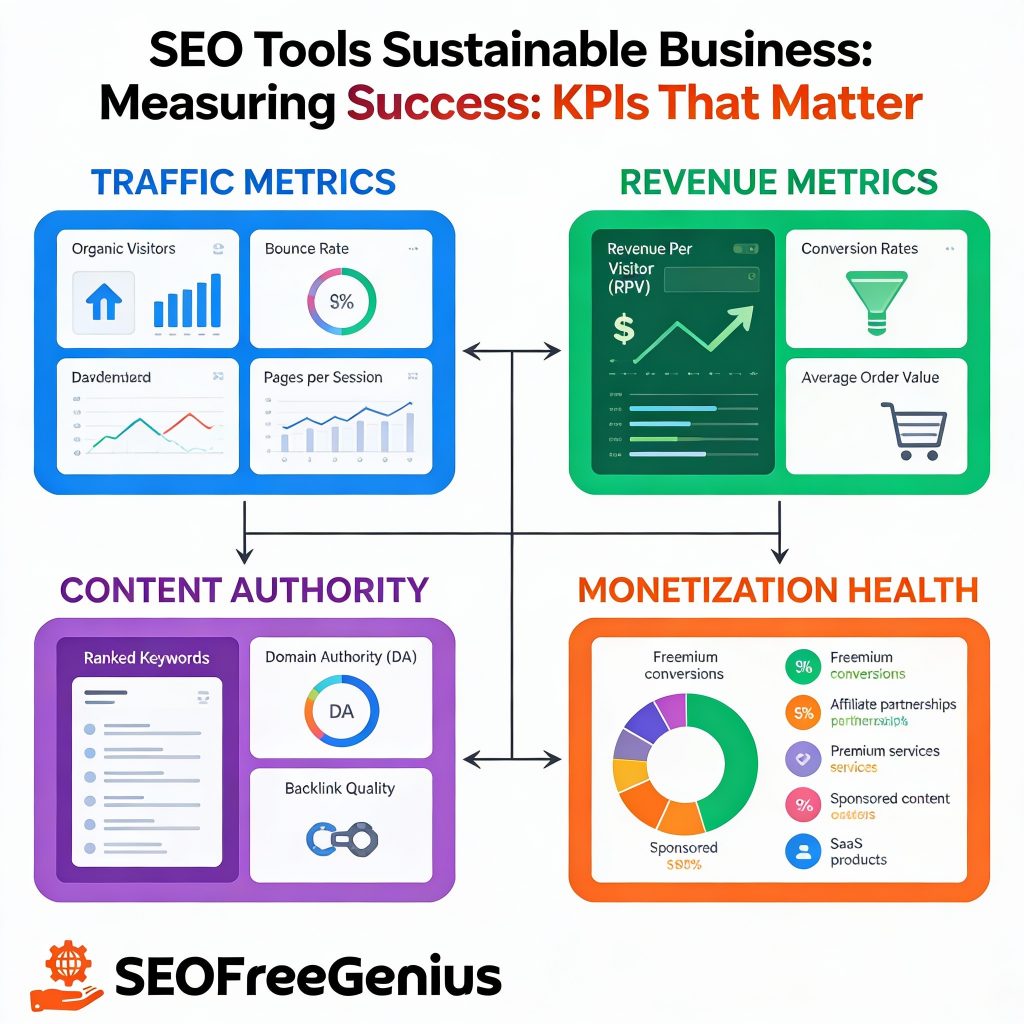
Track these metrics to ensure your monetization strategy is working:
- Monthly organic visitors: Track growth month-over-month
- Average session duration: Should increase as content quality improves
- Bounce rate: Target <45% (indicates engaged, quality traffic)
- Pages per session: Target >2.5 (shows users exploring multiple tools/content)
Goal: 100,000 monthly organic visitors within 12 months
- Revenue per visitor (RPV): Total revenue ÷ monthly visitors
- Affiliate conversion rate: Percentage of recommended tools users actually purchase
- Premium tier conversion rate: Percentage of free users upgrading to paid
- Customer lifetime value (CLV): Estimated revenue per user over their lifetime
Goal: $0.10-0.20 RPV (sustainable and ethical monetization)
- Ranked keywords: Number of keywords in top 10 results
- Backlinks: Total referring domains linking to your content
- Domain Authority (DA): Industry-standard metric (target DA 30+ within 12-18 months)
- Content pieces: Number of published guides and articles
Goal: Authority sufficient to rank for 50+ commercial keywords
- Organic traffic percentage: 75%+ of revenue should come from organic (not paid ads)
- Affiliate revenue percentage: 30-40% of total revenue
- Premium revenue percentage: 20-30% of total revenue
- Ad revenue percentage: 10-20% of total revenue (supplementary only)
The Future: Building a Legacy Business
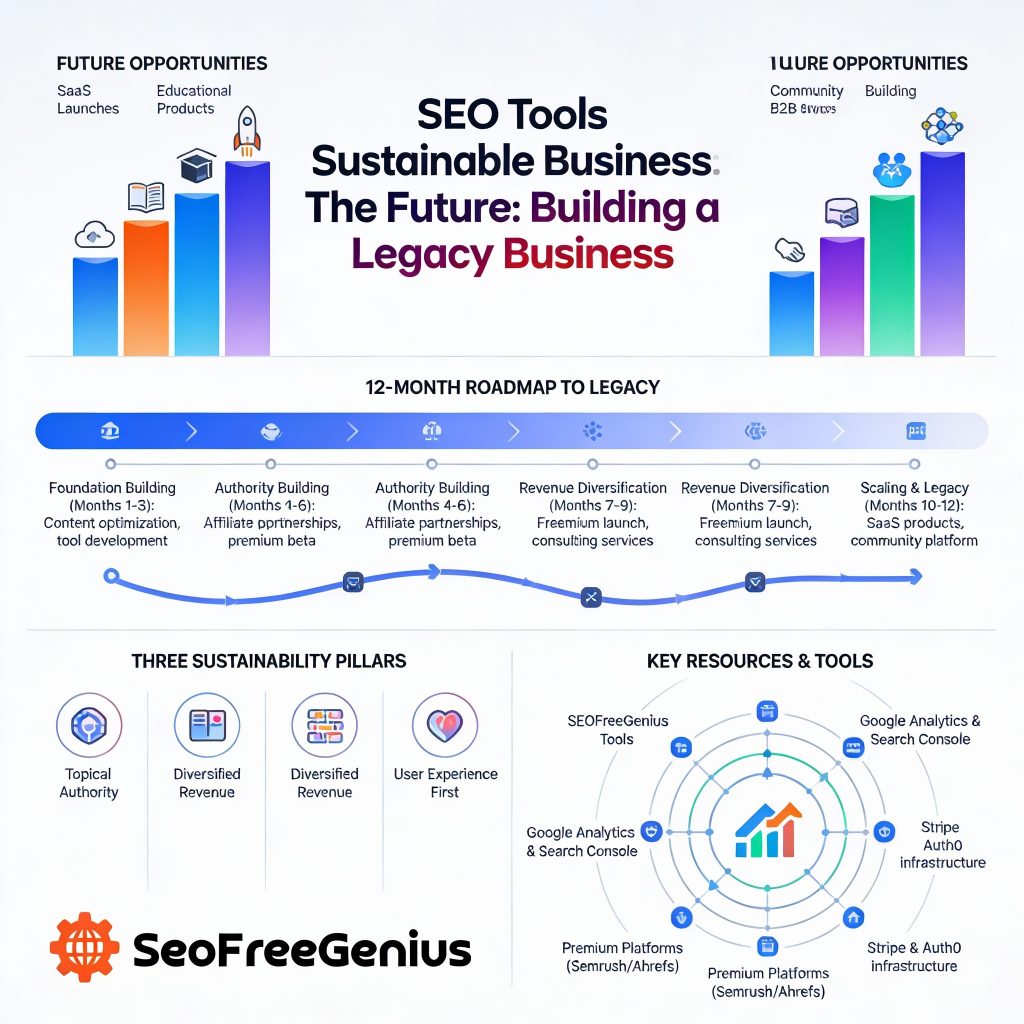
By month 12-18, your free tools website will have transformed into a sustainable business. But the opportunity extends far beyond that.
Phase 2 opportunities (Months 13-24):
- SaaS Product Launch
• Develop a rank tracking tool: $29-99/month
• Build competitor intelligence platform: $49-149/month
• Create backlink monitoring solution: $39-99/month
• Expected revenue: $5,000-15,000/month - Educational Products
• Sell SEO courses for $97-297 each
• Develop certification program for professionals
• Create video training library with paywall
• Expected revenue: $2,000-8,000/month - B2B Services
• Offer white-label tools to agencies
• Sell data licensing to other SEO platforms
• Provide consulting to enterprise brands
• Expected revenue: $3,000-10,000/month - Community Building
• Launch membership community with exclusive content
• Host live webinars and Q&A sessions
• Build networking opportunities for members
• Expected revenue: $2,000-6,000/month
• Expected revenue: $2,000-6,000/month
Conclusion: Turning Free Into Fortune
The secret to turning a free SEO tools website into a sustainable, profitable business isn’t complicated. It requires:
- Unwavering commitment to user experience — Never sacrifice utility for revenue extraction
- Strategic content authority building — Become an educator, not just a tool provider
- Diversified revenue streams — Don’t rely on a single monetization channel
- Long-term thinking — Build for sustainability, not quick profits
- Authentic recommendations — Only promote products you genuinely believe in
The brands that succeed—like SEOFreeGenius—understand that trust is the most valuable commodity. Users will happily upgrade to premium features, click affiliate links, and pay for services when they’ve experienced genuine value from your free offerings.
Start with exceptional free tools and content. Build an engaged, loyal audience. Then monetize through multiple, non-intrusive channels. This approach generates sustainable revenue while maintaining the user trust that built your business in the first place. Your journey from free to profitable begins not with monetization strategy, but with a simple question: “How can I provide exceptional value to my users?” Answer that question consistently, and profitability will follow naturally.
Key Resources for Getting Started
- SEOFreeGenius Keyword Research Tools — Free keyword analysis and research
- Ubersuggest — Free keyword ideas, search volume, and difficulty
- Plausible Analytics — Lightweight, privacy‑friendly analytics for pageviews and goals.
- Google Search Console — Monitor search visibility and indexing
- WebPageTest — Core Web Vitals + multi-location speed tests
- GTmetrix — Detailed performance testing
- Semrush — Premium SEO platform for advanced features (when users are ready to upgrade)
- Ahrefs — Backlink analysis and competitive intelligence