
Introduction
Google AI Overviews SEO in 2025 dominates over 50% of search results…
Google AI Overviews dominate over 50% of search results in 2025, pulling content from top-ranked pages to deliver instant answers directly to users. This comprehensive guide provides actionable strategies to get your content cited, improve rankings, and boost Google indexing using proven tactics from Google’s own guidelines. Throughout this guide, you’ll discover how tools available at seofreegenius can help analyze keywords, backlinks, and site performance to complement your AI Overviews optimization strategy.
Understanding AI Overviews and Their Impact on SEO
AI Overviews use the same ranking systems as traditional search—PageRank, Helpful Content Update, and E-E-A-T signals—but prioritize concise, authoritative answers pulled from top-10 organic results, which supply 92% of all citations. The key to success is understanding that AI Overviews aren’t replacing traditional rankings; they’re enhancing them by surfacing the most valuable content for specific query types. Focus your optimization efforts on informational queries in YMYL topics where depth and expertise win, and avoid commercial intent keywords where paid ads dominate. Use [seofreegenius.com Keywords Toolkit] – including Keyword Position Checker, Keyword Density Checker, Keywords Suggestion Tool, and Keyword CPC Calculator – to identify opportunity gaps in your niche and discover which queries appear in AI Overviews.
AI loves video content. Use our [YouTube Keywords Extractor] to find the exact tags your competitors use to rank their videos.
Key Statistics About AI Overviews
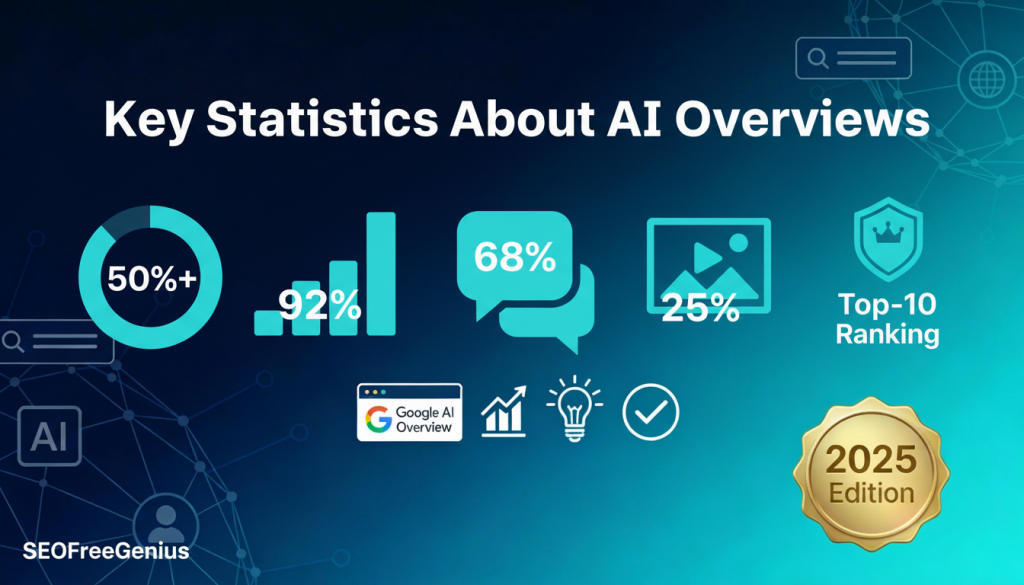
- Over 50% of Google searches now include AI Overviews
- 92% of AI Overviews citations come from top-10 ranking pages
- 68% of Overviews include Reddit or forum mentions
- 25% of Overviews feature multimodal content (images and videos)
- Pages need to rank in top-10 organically before AI citation is possible
AI Overviews SEO 2025 Content Strategy
Write for People First, AI Second
The foundation of AI Overviews optimization is creating genuine, useful content for human readers. Google’s Helpful Content guidelines emphasize that AI systems reward pages demonstrating deep expertise and authentic value.
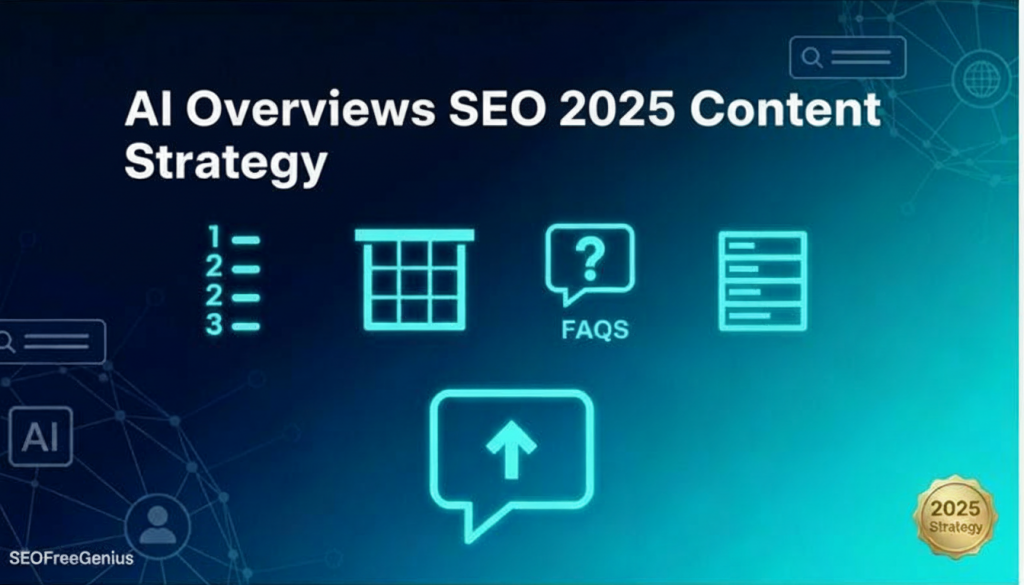
Your content should answer queries directly in the first 100-200 words using natural language that real people use. Structure your content with clear H1-H3 headings, numbered lists, tables, and FAQs formatted for easy extraction by AI systems. Target long-tail conversational keywords like “how to rank in AI Overviews 2025” and match featured snippet styles—definitions, step-by-step guides, and comparison tables.
Use plagiarism checkers to ensure complete originality before publishing, as uniqueness boosts E-E-A-T signals that AI systems heavily favor. Original research, unique data points, and personal expertise citations all strengthen your content’s authority.
Content Formats That Win AI Citations
| Content Format | Why It Works for AI | Implementation Example | |
| Short Paragraphs | Easy parsing and quick comprehension | “AI Overviews appear in 50%+ searches, pulling answers from top-ranking pages.” | |
| Numbered Lists | Step-by-step extraction | How-to guides with clear sequential steps | |
| Tables with Headers | Structured comparisons | Tools vs. Features, Pros vs. Cons tables | |
| FAQs with Schema | Direct Q | A extraction | Common questions with detailed answers |
| Comparison Charts | Contextual decision-making | Side-by-side feature comparisons |
Table 1: Content formats that optimize for AI Overviews extraction
AI Overviews SEO 2025 Technical SEO
Core Web Vitals and Site Performance
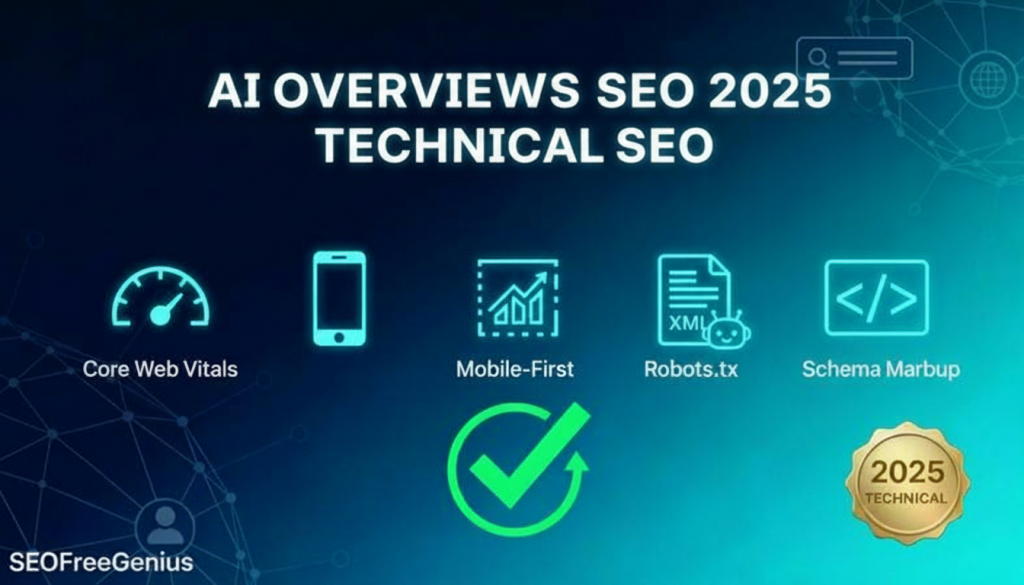
Ensure your site’s Core Web Vitals scores are in the green range:
- Largest Contentful Paint (LCP): <2.5 seconds
- First Input Delay (FID): <100 milliseconds
- Cumulative Layout Shift (CLS): <0.1
- Mobile-first indexing: Fully optimized for mobile devices
These metrics directly impact your eligibility for AI Overviews, as Google prioritizes fast, user-friendly sites. Monitor performance regularly using the [Website Management Toolkit at seofreegenius] – including Page Speed Checker, Page Size Checker, XML Sitemap Generator, and Robots.txt Generator – to identify bottlenecks and resolve them quickly.
Verify that your robots.txt file allows Googlebot access to all important content, and create comprehensive XML sitemaps covering every page. Remove any noindex tags from pages you want indexed, and fix crawl errors immediately in Google Search Console. Ensure your site structure follows a logical hierarchy that both users and crawlers can navigate easily.
Implement Structured Data Markup
Schema markup helps AI systems understand your content’s context and meaning. Implement the following Schema types across your site:
- FAQPage Schema – For pages with frequently asked questions
- HowTo Schema – For step-by-step guides and tutorials
- Article Schema – For blog posts and news content
- Organization Schema – For company information and credibility
- Person Schema – For author bylines and expert credentials
- Product Schema – For product reviews and comparisons
- BreadcrumbList Schema – For site navigation clarity
Deploy JSON-LD Schema for entities like Person (authors), Organization, and Product to create knowledge graph connections that AI recognizes. AI systems extract structured data 3x more often than unstructured content, making proper markup implementation critical.
Validate your meta tags with meta tag analyzer and ensure every page has unique, descriptive title tags (50-60 characters) and meta descriptions (120-160 characters).
💡 Pro Tip: Structured data is key, but don’t forget the basics. Use our [Meta Tag Generator] to ensure your code is perfectly clean for AI bots.
Authority Building and E-E-A-T Signals

Establish Expertise, Authoritativeness, and Trustworthiness
E-E-A-T signals are paramount for AI Overviews selection. Build these signals by:
- Including detailed author bios with credentials and expertise in your field
- Citing primary sources and linking to authoritative research
- Displaying trust indicators (SSL certificates, privacy policies, contact information)
- Publishing original research or data unique to your domain
- Earning mentions on high-authority websites and industry publications
- Creating content that demonstrates hands-on experience with the topic
- Maintaining consistent brand presence across multiple platforms
Backlink Strategy for AI Visibility
Secure backlinks from DR 50+ authority sites, as AI Overviews heavily weight citations from trusted domains. Target “Best Of” lists, industry roundups, and expert contributor opportunities. Research competitor backlinks using our Backlink Checker to find referring domains and anchor text patterns.
Build genuine authority through guest posts, interviews, and expert contributions rather than manipulative link schemes. Monitor your backlink profile regularly to disavow toxic or irrelevant links that could harm your AI ranking potential.
Leverage Social Proof and Community Mentions
68% of AI Overviews include mentions from Reddit, forums, or community discussions. Engage authentically in relevant communities, answer questions in your niche, and build a reputation as a helpful expert. These organic brand mentions signal trustworthiness to AI systems.
Multimedia Optimization for AI Overviews
Include high-quality, relevant images with descriptive file names and comprehensive alt text. Multimodal AI—systems that understand text, images, and video—appears in 25% of Overviews. Optimize images for fast loading by:
- Using modern formats (WebP)
- Compressing without quality loss
- Implementing responsive image sizes
- Adding captions and detailed alt text
Use the Images Editing toolkit – including tools like Color Picker, RGB to Hex, Hex to RGB, and Dummy Image Placeholder – to prepare and optimize images while maintaining quality and supporting better page speed and Core Web Vitals.
Embed relevant videos from YouTube or native uploads with transcripts and proper markup. Add video schema markup to help AI understand video content. Videos increase engagement time and provide additional citation opportunities in AI Overviews.
To see what visual styles are winning in your niche, use our [YouTube Thumbnail Downloader] to analyze successful competitor videos.
Content Freshness and Updating Strategy
Refresh your top-performing pages quarterly, updating statistics, adding new insights, and removing outdated information. AI systems recognize recently updated content as more relevant and trustworthy. Focus updates on:
- Pages that appear in AI Overviews
- Competitive ranking pages
- Evergreen content with long shelf lives
- Articles targeting trending topics
Track AI citations using tools like Semrush, Ahrefs, or manual searches. Test by searching your target keywords incognito, noting which pages appear in AI Overviews. Monitor site performance and domain metrics using the [Website Tracking Toolkit](https://seofreegenius.com/) – including Domain Authority Checker, PageSpeed Insights, Google Index Checker – and [Domains Toolkit](https://seofreegenius.com/) – Domain Age Checker, DNS Records, Blacklist Lookup – for complete analysis.
Create a tracking spreadsheet documenting:
- Target keywords
- Current ranking position
- AI Overview appearance (yes/no)
- Citation frequency
- Monthly updates made
Advanced AI Overviews Optimization Tactics
Organize content into topic clusters with a comprehensive pillar page and detailed cluster content linking back to the pillar. This structure helps AI understand your authority on broad topics. For example, create a pillar on “SEO Strategy” with cluster pages on keyword research, technical SEO, content optimization, and link building.
Use the [Keywords Toolkit](https://seofreegenius.com/) – including Keywords Suggestion Tool, Keyword Position Checker, and Keyword Density Checker – to identify all related questions users ask about your topic. Create dedicated content or FAQ sections answering each question. AI Overviews often pull multiple answers from different sections of high-authority pages, so comprehensive coverage increases citation opportunities.
Leverage AI-Generated Insights Responsibly
Use AI tools to enhance your research, identify gaps, and refine writing, but always verify information and add original insights. Google penalizes unhelpful AI-generated content but rewards genuinely useful content created with AI assistance.
AI Overviews SEO 2025 Success Metrics
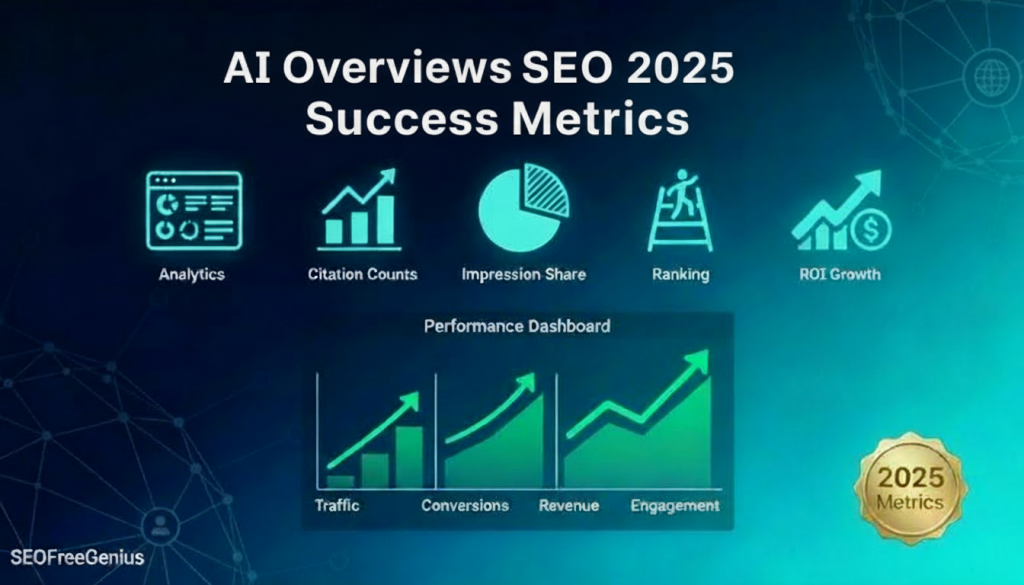
Track your AI Overviews SEO 2025 performance monthly…
Key Metrics Beyond Click-Through Rate
AI Overviews success isn’t just about clicks—it’s about brand building and authority growth:
- AI Impression Share – Percentage of searches showing your site in Overviews
- Citation Frequency – How often your pages appear in AI extracts
- Ranking Position – Maintain top-10 positions for maximum visibility
- Brand Mentions – Growth in unlinked brand references
- Domain Authority – Improvement in backlink quality and quantity
- Engagement Metrics – Time on page, scroll depth, return visitors
- Indexing Coverage – Total indexed pages and crawl health
Before publishing or updating content for AI Overviews:
- Content answers target query in first 100 words
- Minimum 2,000+ words with multiple H2/H3 sections
- At least 3 content format types (lists, tables, paragraphs)
- Schema markup implemented (Article, FAQPage, or HowTo)
- Unique, valuable insights with citations to authoritative sources
- Images optimized with alt text and captions
- Meta title (50-60 characters) and description (120-160 characters)
- Internal linking to related cluster content
- Mobile responsiveness and Core Web Vitals green scores
- Author bio with expertise credentials
- Plagiarism check completed
- External links to DR 40+ authority sources
- Updated within the last 3 months
Common Mistakes to Avoid
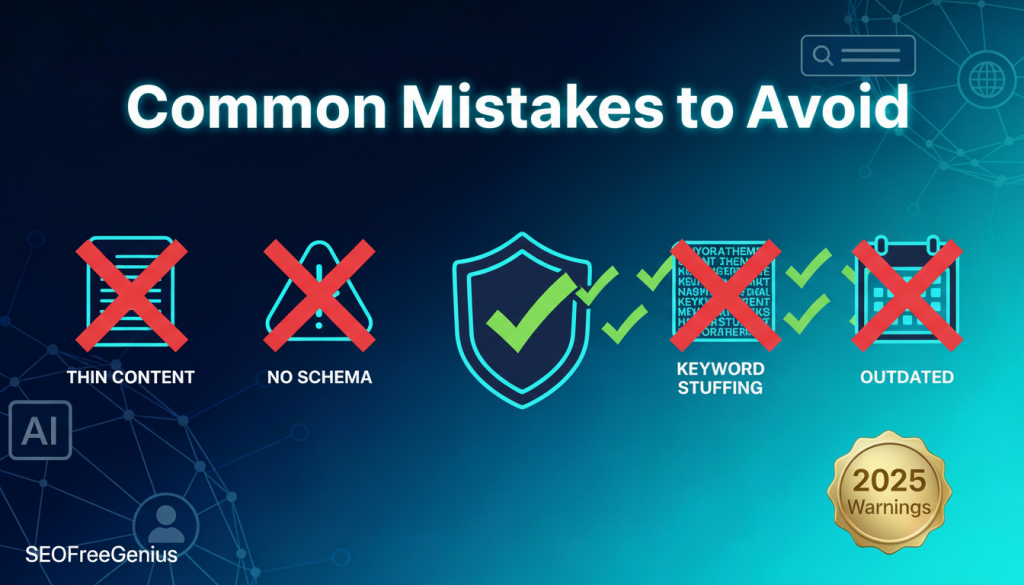
- Thin Content – Pages under 1,500 words rarely appear in Overviews
- No Schema Markup – Missing structured data reduces extraction chances
- Poor Core Web Vitals – Slow sites don’t rank for AI Overviews
- Keyword Stuffing – AI detects and penalizes unnatural language
- Outdated Information – Refresh regularly or lose visibility
- Low Authority – Fewer than 10 referring domains limits opportunities
- Ignoring E-E-A-T – Lack of credibility signals disqualifies pages
- Duplicate Content – Internal duplication confuses AI parsing
- Blocked Images – Crawling issues prevent mult-imodal inclusion
Future-Proofing Your AI Overviews Strategy
Stay Ahead of Algorithm Changes
Subscribe to Google Search Central announcements and SEO industry updates to adapt quickly to algorithm changes. AI Overviews will continue evolving, potentially including video snippets, more personalization, and enhanced multimodal content.
Diversify Your Traffic Sources
While optimizing for AI Overviews, maintain presence on:
- Voice search and smart speakers
- Social media platforms (especially Reddit, LinkedIn)
- Email marketing and newsletters
- Direct domain traffic
Pages featuring original data, surveys, or case studies earn more citations than aggregated content. Publish unique insights that competitors can’t replicate, positioning your brand as a thought leader.
Conclusion
Optimizing for AI Overviews in 2025 requires a balanced approach combining traditional SEO excellence with AI-specific tactics. Focus on creating genuinely helpful, people-first content that demonstrates expertise, authority, and trustworthiness. Implement proper technical foundations, structured data markup, and authority-building strategies to maximize your visibility.
Start implementing AI Overviews SEO 2025 strategies today…