
Introduction
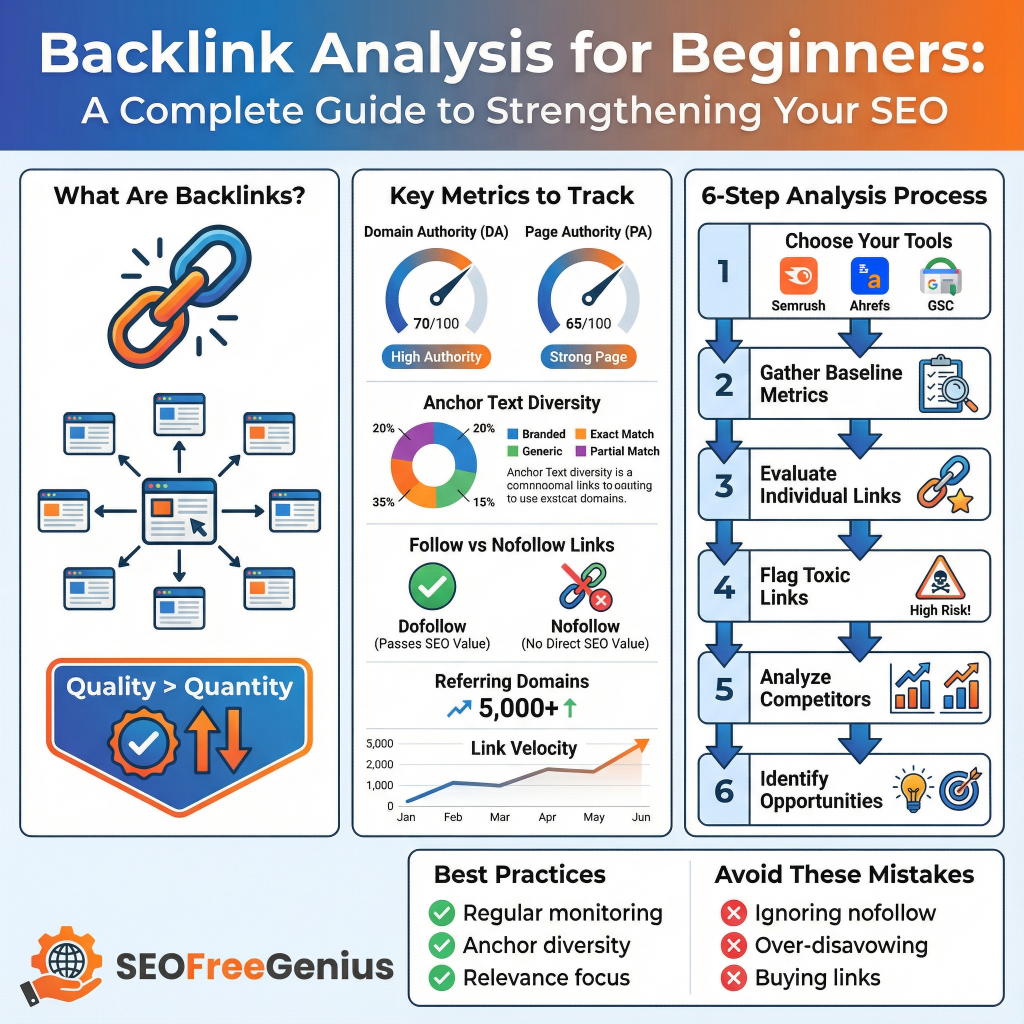
Backlinks are one of the most critical factors in Google’s ranking algorithm, yet many website owners and beginners don’t fully understand how to analyze them effectively. Whether you’re running a blog, e-commerce site, or corporate website, understanding your backlink profile is essential for improving your search engine rankings and organic traffic.
In this comprehensive guide, we’ll walk you through everything you need to know about backlink analysis—from identifying your existing backlinks to developing a data-driven strategy that’ll help you outrank your competitors.
What is Backlink Analysis?
Backlink analysis is the process of evaluating all external links pointing to your website to understand their quality, relevance, and impact on your SEO performance. It involves examining metrics such as domain authority, anchor text, referring domains, and link relevance to assess how well your backlink profile supports your overall SEO strategy.
Think of backlinks as “votes of confidence” from other websites. The more high-quality votes you receive from authoritative sources, the stronger your website appears to search engines. However, not all backlinks are created equal—some can actually harm your rankings if they come from spammy or irrelevant sources.
Why Is Backlink Analysis Important for SEO?
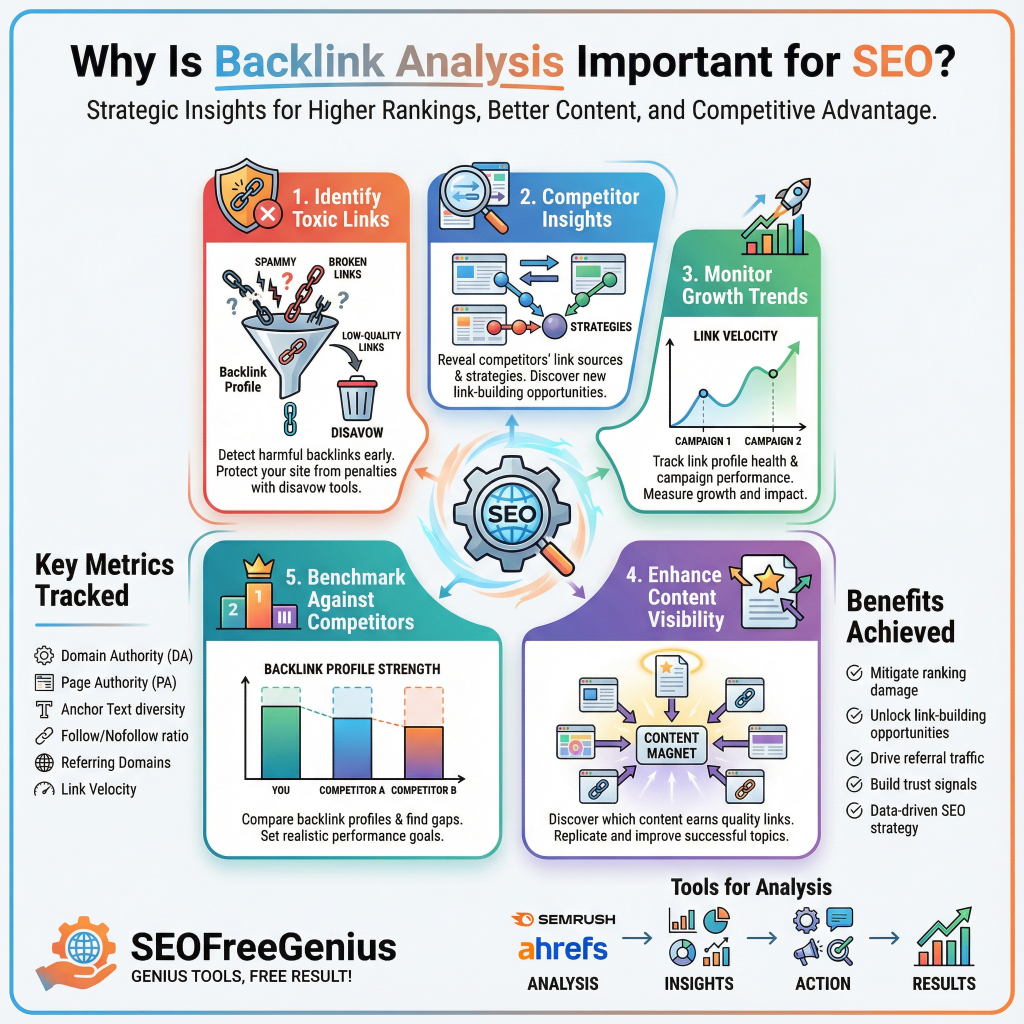
Understanding your backlink profile provides several critical benefits:
1. Identify Toxic or Harmful Links
Low-quality or spammy backlinks from unrelated websites can negatively impact your SEO performance. Backlink analysis helps you spot these problematic links early so you can disavow them before they damage your rankings.
2. Discover Competitor Opportunities
By analyzing where your competitors are getting their backlinks, you can identify link-building opportunities you might have missed. This competitive intelligence allows you to replicate successful strategies within your industry.
3. Monitor Link Velocity and Growth
Tracking how quickly your backlink profile grows helps you identify trends and anomalies. Sudden spikes or drops in backlinks can indicate successful campaigns or potential issues that need investigation.
Quality backlinks drive referral traffic to your website while signaling to Google that your content is valuable and trustworthy. A comprehensive backlink analysis helps you understand which content attracts links and how to create more linkable assets.
5. Benchmark Against Competitors
Comparing your backlink profile with competitors helps you understand your competitive position and identify areas where you need improvement to maintain or gain market share in search results.
Key Metrics for Backlink Analysis
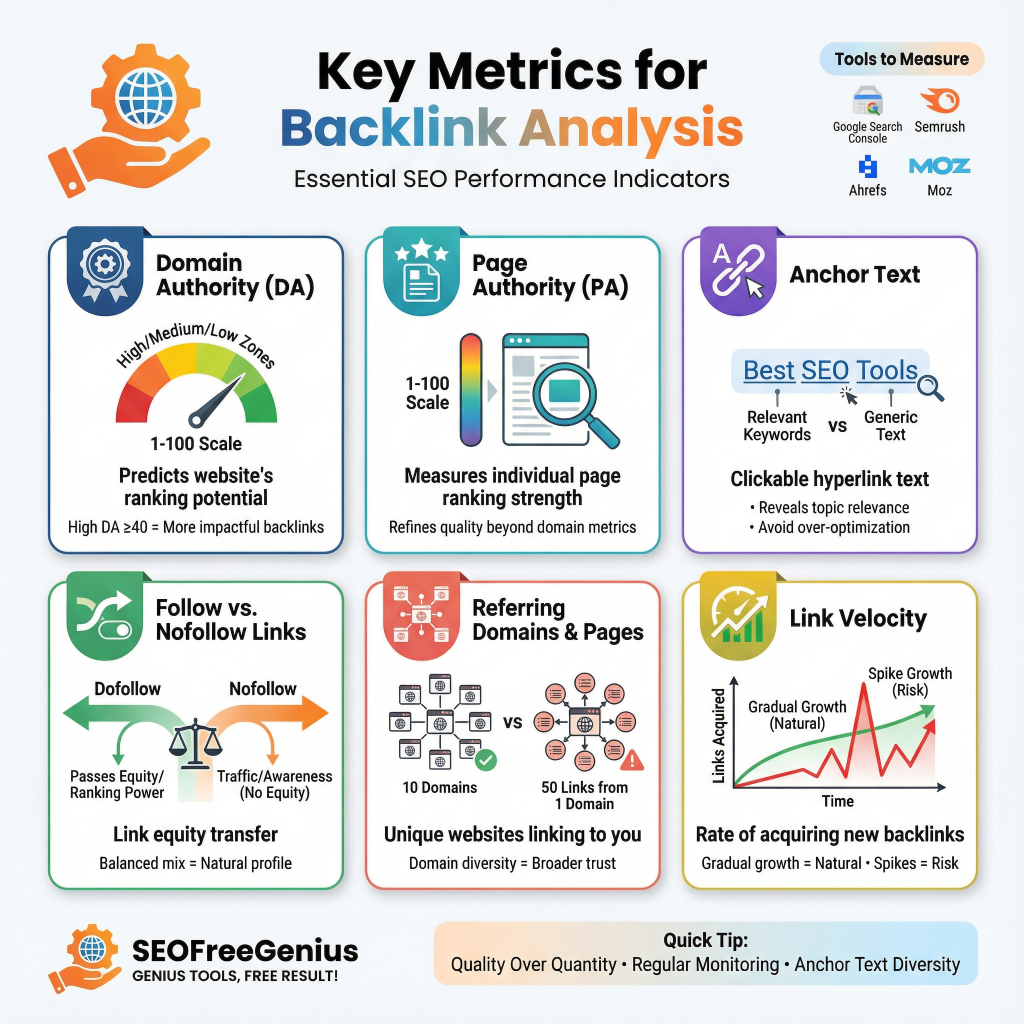
Before diving into the tools and processes, familiarize yourself with these essential backlink metrics:
Domain Authority is a score from 1-100 that predicts how well a website will rank in search results. Backlinks from high-authority domains (DA 40+) carry significantly more weight than links from new or low-authority domains. When analyzing backlinks, prioritize those coming from domains with strong authority scores.
Don’t guess your score. See exactly where you stand right now with our [Domain Authority Checker].
Similar to Domain Authority, Page Authority measures the ranking strength of individual pages. Even high-authority domains can have low-authority pages, so evaluating both metrics gives you a complete picture of link quality.
Anchor text is the clickable text in a hyperlink. Search engines use it to understand what your page is about. Ideally, your backlinks should use relevant keywords as anchor text—but avoid over-optimization, which can trigger Google penalties.
Not sure which keywords to target? Find the best terms for your niche with our [Keywords Suggestion Tool].
Dofollow links pass link equity to your site and directly impact rankings, while nofollow links don’t directly influence your search rankings but can still drive referral traffic and brand awareness. A healthy backlink profile includes both types.
Referring Domains and Referring Pages
The number of unique domains linking to you is more important than total backlinks. Ten backlinks from ten different domains carry more weight than fifty links from a single domain. Similarly, tracking referring pages helps you understand which content is attracting links.
Link velocity measures how quickly your website is acquiring new backlinks over time. A healthy, gradual increase in backlinks looks natural to Google, while sudden spikes might trigger manual review.
How to Conduct a Backlink Analysis: Step-by-Step
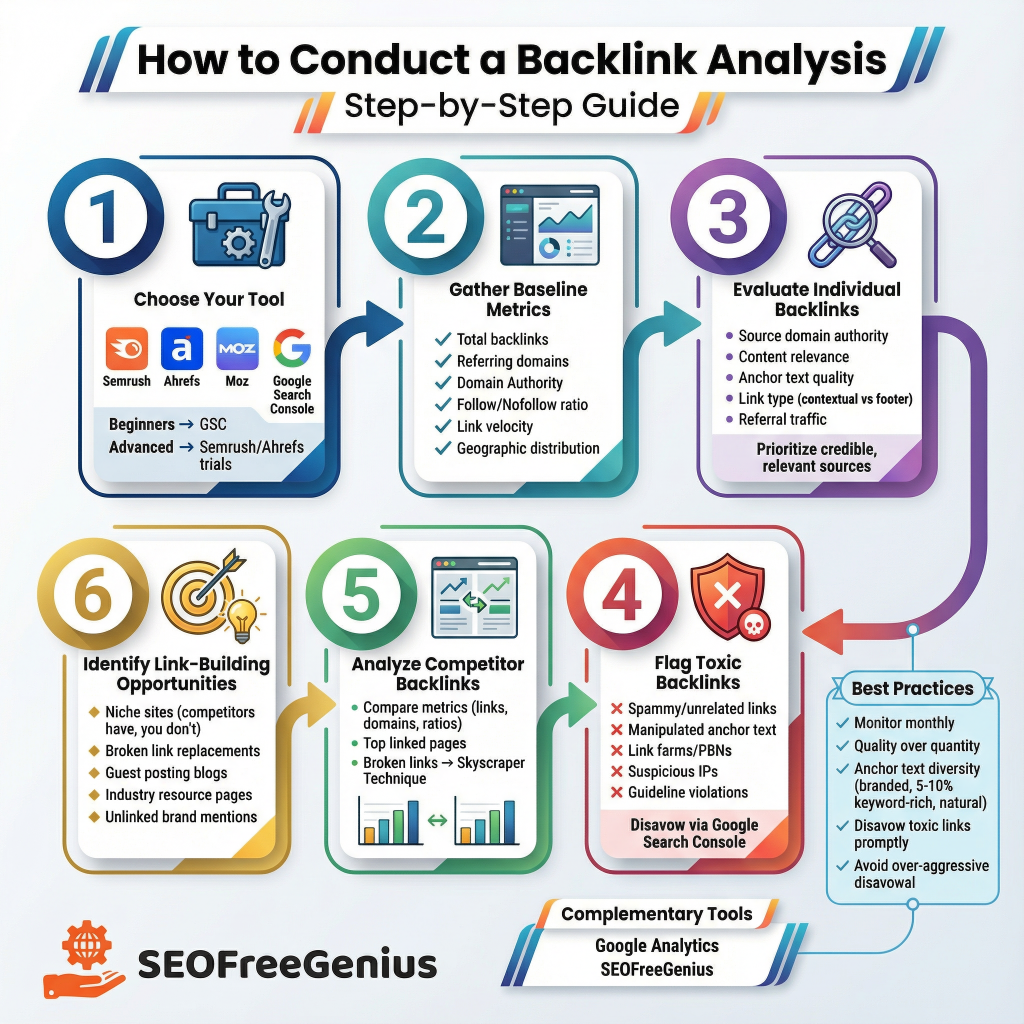
Step 1: Choose a Backlink Analysis Tool
The first step is selecting a reliable backlink analysis tool. Here are the most popular options:
Free Option: Just starting out? You don’t need a $100 subscription. Check your backlinks instantly with our free [Backlink Checker].
Semrush is one of the most comprehensive SEO platforms available. Its Backlink Audit tool analyzes your backlink profile against 50+ parameters, including authority, toxicity scores, and anchor text distribution. You can even connect your Google Analytics account to track referral traffic from each domain.
Ahrefs provides an extensive backlink database with trillions of links indexed. Its Site Explorer tool allows you to analyze your backlink profile, monitor new and lost links, and perform competitor backlink analysis with detailed filtering options.
Moz Link Explorer offers real-time tracking of your backlink profile and includes features like Link Intersect, which reveals backlink opportunities you might be missing by analyzing gaps between your profile and competitors’.
Google Search Console is a free tool directly from Google. While it doesn’t provide as much detail as premium tools, it gives you official data about the links Google has discovered pointing to your site.
For beginners on a budget, Google Search Console is an excellent starting point. For more advanced analysis, consider a trial of Semrush or Ahrefs to explore their full capabilities.
Step 2: Gather Your Baseline Metrics
Start by collecting key metrics about your current backlink profile:
- Total number of backlinks
- Number of referring domains
- Domain authority rating
- Distribution of follow vs. nofollow links
- Link velocity (rate of acquiring new backlinks)
- Geographic distribution of referring domains
These metrics establish your baseline and help you track progress over time. They also provide context for understanding whether your backlink profile is healthy or needs improvement.
Step 3: Identify and Evaluate Individual Backlinks
Once you have your overall metrics, dive deeper into individual backlinks. For each link, evaluate:
- Source domain authority: Is it from a reputable, high-authority site?
- Content relevance: Does the linking site operate in your industry? Is the content surrounding the link relevant to yours?
- Anchor text: Is it natural and keyword-relevant, or does it look over-optimized?
- Link type: Is it a contextual link within content, or a footer/sidebar link?
- Referral traffic: Does the link actually drive visitors to your site?
Ask yourself: “Would my target audience find this website credible and beneficial?” If the answer is no, the backlink may be low-quality regardless of its metrics.
Step 4: Spot and Flag Toxic Backlinks
Toxic backlinks can harm your rankings and should be removed or disavowed. Red flags include:
- Links from spammy or unrelated websites
- Links with anchor text that appears manipulated or irrelevant
- Links from link farms or private blog networks (PBNs)
- Links with suspicious referring IP addresses
- Links that violate Google’s Webmaster Guidelines
If you identify toxic links, use Google Search Console’s Disavow Links tool to tell Google to ignore them.
Step 5: Analyze Competitor Backlinks
Understanding where your competitors are getting their backlinks provides invaluable strategic insights. Look at:
- Total backlinks and referring domains
- Follow vs. nofollow ratio
- Domain authority of their referring sites
- Link relevance and industry alignment
- Top linked pages (which of their pages attract the most links?)
- Broken backlinks (pages that no longer exist but still receive links)
For broken links, you can use the “Skyscraper Technique”—create updated, better content on the same topic and reach out to sites linking to the broken page, asking them to link to your improved version instead.
Step 6: Identify Link-Building Opportunities
Based on your analysis, identify where you can acquire more high-quality backlinks:
- Industry websites and blogs: Which sites in your niche link to competitors but not to you?
- Broken link opportunities: Find broken links on relevant sites and offer your content as a replacement
- Guest posting: Identify blogs that accept guest contributions in your industry
- Resource pages: Look for “Best Tools,” “Top Resources,” or similar pages that mention competitors
- Mentions without links: Find places where your brand is mentioned but not linked, and request a link addition
These opportunities become your actionable link-building roadmap.
Best Practices for Backlink Analysis
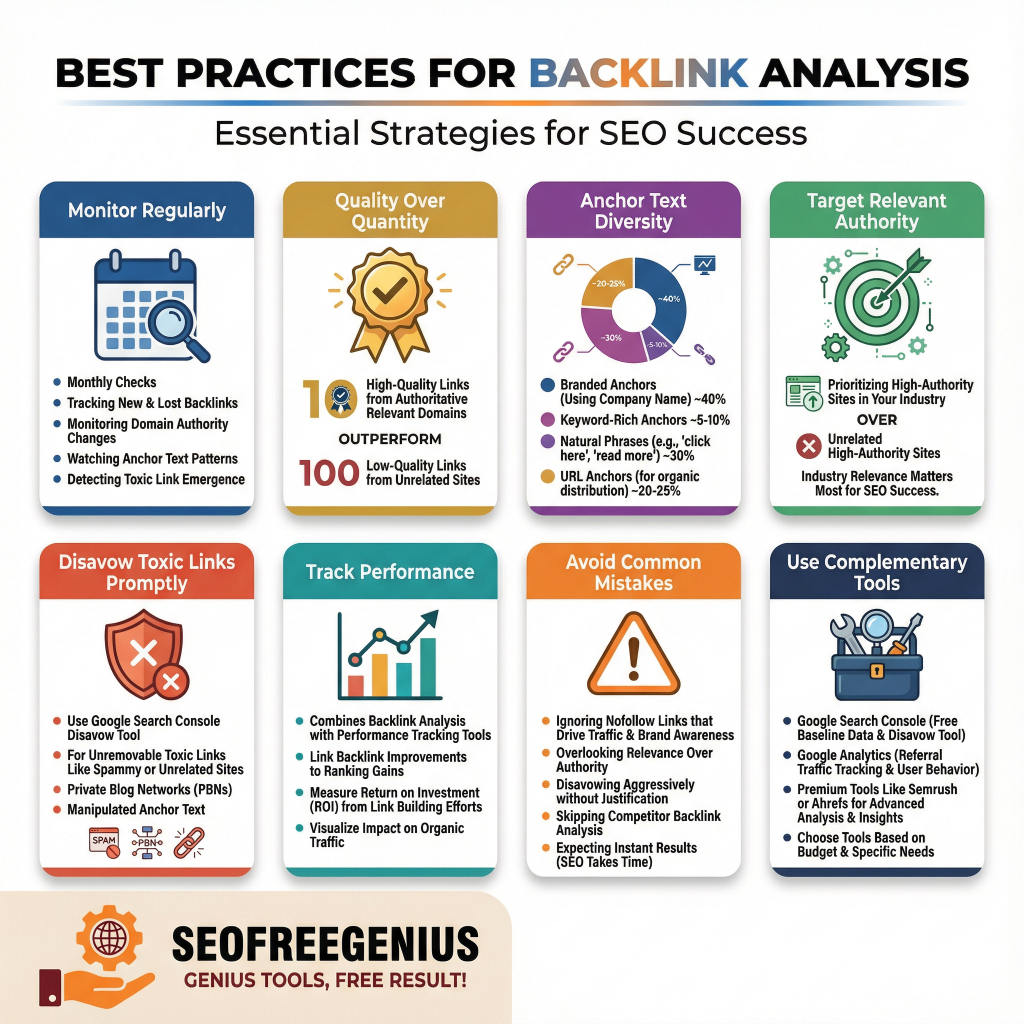
Monitor Your Backlinks Regularly
Backlink analysis isn’t a one-time task. Set up monthly monitoring to track:
- New backlinks acquired
- Lost backlinks
- Changes in referring domain authority
- Anchor text patterns
- Toxic link emergence
Regular monitoring helps you catch problems early and capitalize on successful link-building campaigns.
Focus on Quality Over Quantity
Ten backlinks from authoritative, relevant domains will always outperform a hundred links from low-quality sources. When building your link profile, prioritize quality and relevance above all else.
Maintain Anchor Text Diversity
Avoid over-optimization by maintaining natural anchor text diversity. Your backlinks should include:
- Branded anchor text (your company name)
- Keyword-rich anchor text (5-10% of your links)
- Natural phrases and URL anchors (the majority)
This natural distribution looks more organic to search engines.
Build Links from Relevant, Authoritative Sources
Google increasingly values topical relevance. A backlink from a high-authority site in your industry is worth far more than a link from an equally authoritative site in an unrelated field. Focus on acquiring links from relevant websites.
Don’t let toxic links accumulate. If you identify backlinks from spammy sources that you can’t get removed through outreach, use the Disavow Links tool in Google Search Console to prevent them from harming your rankings.
Track and Analyze Performance Use SEOFreeGenius tools to complement your backlink analysis with comprehensive SEO metrics. Their suite of free tools includes website analysis, domain analysis, and performance tracking features that help you understand how your backlink improvements translate into actual ranking gains.
Common Backlink Analysis Mistakes to Avoid
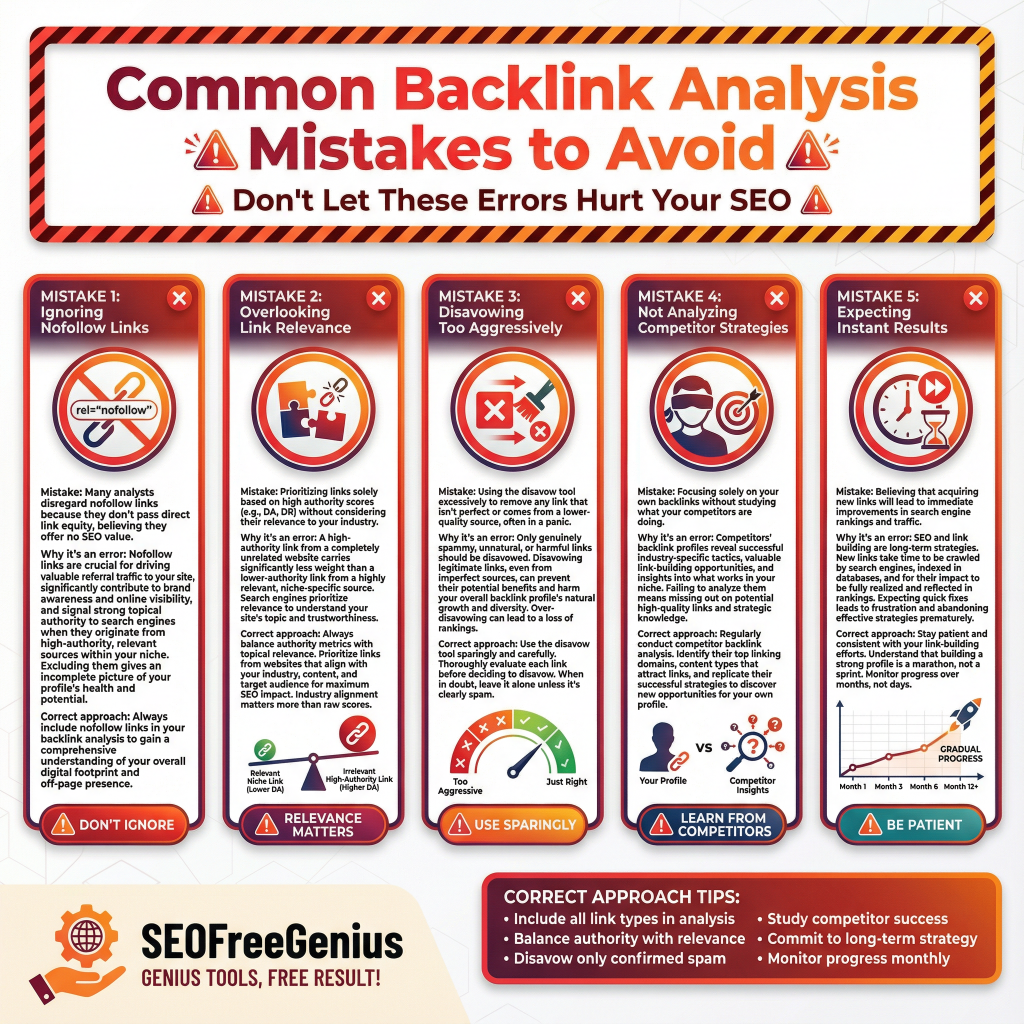
While nofollow links don’t directly pass link equity, they still matter. They drive referral traffic, build brand awareness, and from high-authority sources, they signal topical authority. Include them in your analysis.
A link from a high-authority site in an unrelated industry is less valuable than a link from a lower-authority site in your niche. Always prioritize relevance alongside authority metrics.
3. Disavowing Too Aggressively
Only disavow links that are genuinely spammy. Disavowing legitimate links (even from less-than-perfect sources) can prevent those links from helping your site. Use disavowal sparingly.
4. Not Analyzing Competitor Strategies
Your competitors’ backlink profiles reveal successful tactics in your industry. Failing to analyze them means missing valuable opportunities and insights.
Improving your backlink profile is a long-term strategy. It takes time for new links to be crawled, indexed, and factored into rankings. Stay patient and consistent.
Tools That Complement Backlink Analysis
While you’re conducting backlink analysis, use complementary tools to enhance your SEO strategy:
- SEOFreeGenius offers free text utilities for plagiarism checking and writing refinement, plus comprehensive keyword research tools and domain analysis features
- SEOFreeGenius Blog provides in-depth guides like “SEO for Complete Beginners: How Google Finds and Ranks Your Website,” giving you context for why backlinks matter
- Google Search Console provides official backlink data directly from Google
- Google Analytics tracks how backlinks drive referral traffic to your site
- Competitor analysis tools help identify gaps in your link strategy
Conclusion
Backlink analysis is not just a technical SEO task—it’s a strategic process that reveals how search engines perceive your website’s authority, relevance, and trustworthiness. By systematically analyzing your backlink profile, identifying toxic links, learning from competitors, and building high-quality links from relevant sources, you create a strong foundation for sustainable SEO success.
Start with the free tools available in Google Search Console, and as your understanding grows, consider investing in premium tools like Semrush or Ahrefs for deeper insights. Remember, the goal isn’t just to accumulate backlinks—it’s to build a high-quality link profile that genuinely reflects your website’s value and relevance to your audience. Take action today: audit your current backlink profile, identify your first batch of toxic links to disavow, and research your competitors’ most valuable backlinks. Your rankings tomorrow depend on the backlink strategy you implement today.